How Do You Construct a Perpendicular Bisector?
Root Concept
Equal arcs from both ends of a line cross at two points equidistant from each end; the line through them is the perpendicular bisector.
CodePLU Goal
Upgrading Human Mental Models
Learn how to think in Workflows

Concept Development By codeplu.com
The two crossings are each the same distance from A as from B, which is what forces the line through them to bisect.
Finding the Middle Without Measuring It
Measuring an angle with a protractor gives a number read off a scale, and a scale can always be misread. Compass constructions work differently: they produce the answer exactly, with no numbers involved at all. Nothing is measured, so nothing can be measured wrongly.
The perpendicular bisector of a line segment is the line that cuts it exactly in half and crosses it at a right angle. It does two jobs at once, which is why it is the first construction anyone learns. The method is short: open the compasses to more than half the line, draw an arc from each end, and join the two points where the arcs cross. That line is the perpendicular bisector, and it is exact rather than approximately right.
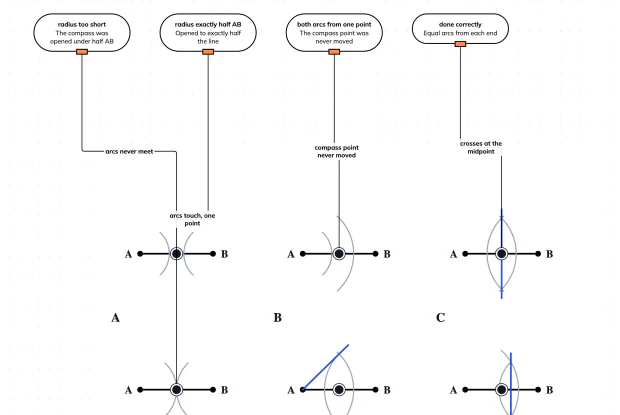
Almost every mistake is in the compass. Open it too little and the arcs never reach each other; open it to exactly half and they touch at one point instead of crossing at two; forget to move the point from A to B and you get two arcs that can never meet. The playground below has all three of those, plus two attempts where the arcs are fine and the construction still fails.
The Method, and Every Way It Goes Wrong
Why does joining the crossings work?
Because both arcs were drawn with the same compass setting. Every point on the arc from A is that distance from A, and every point on the arc from B is the same distance from B, so a point where the arcs cross is exactly as far from A as it is from B. There are two such points, one above the line and one below, and both are equally balanced between the two ends. The line joining them has to pass through the middle of AB, and it has to meet AB squarely — anything else would favour one end over the other. That is the whole proof, and it needs no numbers.
Why must the radius be more than half the line?
So that the arcs actually overlap. The arc from A reaches at most that radius towards B, and the arc from B reaches the same distance back. If the radius is less than half of AB, the two arcs stop short of each other and there is nothing to join, which is panel A in the playground. If the radius is exactly half, they arrive at the same spot from opposite sides and touch at the midpoint without crossing, which is panel D: one point, and one point does not determine a line. Anything more than half gives two crossings, and a radius of about three quarters of the line makes them comfortably far apart and easy to join accurately.
What happens if the compass point does not move?
You get two arcs that are both centred on A, which can never cross each other however wide you open the compass — circles with the same centre and different radii never meet. That is panel B. It sounds like a mistake nobody would make, but it is common when you change the compass setting between arcs and reset the point by habit rather than by looking. The giveaway in a drawing is that both arcs curve the same way: a correct pair bulge towards each other, like brackets facing in, while two arcs from the same centre run parallel. If a construction has produced no crossings at all, this is the first thing to check.
Can the arcs be right and the construction still wrong?
Yes, and two panels show how. In one, the arcs cross properly but the line has been drawn from A to a crossing instead of from one crossing to the other. That line is neither perpendicular nor a bisector; only the line through both crossings has those properties. In the other, the arcs from A and B were drawn at different radii. They still cross at two points, and the line through them is still perpendicular to AB, but it crosses well away from the middle, so it bisects nothing. Equal radii are what make it a bisector, and both crossings are what make it a line. Neither failure is visible in the arcs themselves, which is why reading a construction means looking at what was drawn last as well as what was drawn first.
Real World Example
Siting a Well Between Two Farms
Finding somewhere equally convenient for two places is the perpendicular bisector doing a job, and it explains why the answer is never a single spot.
Step 1
Fair means equidistant
Two farms agree to share the cost of a well and want it equally far from both houses. Mark the two houses as A and B on a plan and the question becomes purely geometric: where are the points the same distance from A as from B? Every such point is a crossing of two equal arcs, one centred on each house, so the set of fair positions is exactly the perpendicular bisector of the line between them. The obvious answer — halfway along the track joining the two farms — is one fair point, but it is only one of infinitely many.
Step 2
The whole line is fair
That matters, because the midpoint of the track might be a bog, or rock, or somebody else's field. Any point on the perpendicular bisector is equally far from both farms, including points well off to one side, so the surveyor has a whole line of options rather than a single spot. They can then pick the point on that line where the water is closest to the surface, or where a vehicle can reach, without either farmer being able to claim the other got the better of it. The geometry settles the fairness and leaves the practicalities free.
Step 3
The same reasoning scales up
Add a third farm and you draw the perpendicular bisector of each pair. The three lines meet at a single point, which is the one place equally far from all three, and it is the centre of the circle passing through all three farms. Mapping services use exactly this to divide a region into the areas nearest each hospital or each school, and the borders they draw are perpendicular bisectors between neighbouring pairs. One school construction turns out to be the basic tool for carving up a map, and the resulting pattern of regions has its own name, the Voronoi diagram.
FAQs
Final Words
A perpendicular bisector is built, not measured. Open the compasses to more than half the line, draw an arc from each end with the same setting, and join the two points where they cross. The equal radii are what make the line bisect, and using both crossings is what makes it a line at all.
Every common failure is a compass failure: too narrow and the arcs miss, exactly half and they only touch, and a point that never moved gives arcs that cannot meet by definition. Keep the arcs on the page as your working. The next construction uses the same equidistance idea on an angle instead of a line, and the method will look familiar.
Continue This Track
This concept is part 1 of Drawing It Yourself.
How Do You Construct a Perpendicular Bisector?
The perpendicular bisector of a line cuts it in half at a right angle, and a pair of compasses finds it exactly. Diagnose six attempted constructions in an interactive playground.
How Do You Bisect an Angle?
Bisecting an angle splits it into two equal halves using compasses only, with no protractor and no measuring. Work out the half-angle for four constructions in an interactive playground.
How Do You Construct a Triangle from Three Sides?
Given three side lengths, a ruler and compasses build the triangle exactly: draw one side, then swing an arc from each end. Find the apex for four triangles in an interactive playground.