How Do You Bisect an Angle?
Root Concept
An arc across both arms, then equal arcs from where it cuts them, meet on the line that splits the angle in half.
CodePLU Goal
Upgrading Human Mental Models
Learn how to think in Workflows

Concept Development By codeplu.com
The construction works for any angle at all, and the two halves it makes are exactly equal, not nearly.
Splitting an Angle Without Measuring It
The perpendicular bisector cut a line exactly in half using nothing but equal distances. This construction does the same thing to an angle, and the idea behind it is almost identical — which is why it is worth meeting straight afterwards.
The method has three steps. Put the compass point on the vertex and draw an arc that crosses both arms. Then move the point to each of those two crossings in turn and draw an arc from each, keeping the compass at the same setting. Those two arcs meet at a point, and the line from the vertex through it splits the angle into two equal halves.
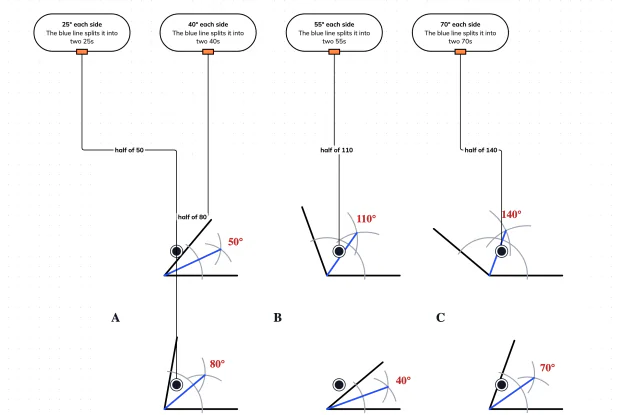
You could get close with a protractor by measuring the angle and halving the number, but that depends on reading a scale correctly and on the angle being an even number of degrees. The construction has neither problem: it is exact for any angle, including awkward ones. In the playground below, four angles have been bisected and your job is to say what each half comes to.
Why It Works, and What to Keep the Same
Why do the two arcs meet on the bisector?
Because of symmetry. The first arc cuts the two arms at points that are the same distance from the vertex — call them P and Q — so the figure is already balanced about the line that would split the angle. Then equal arcs from P and from Q give a crossing point that is the same distance from P as from Q. A point equally far from the vertex-ends of both arms, and equally far from P and Q, can only lie on the line of symmetry of the whole arrangement, which is exactly the bisector. It is the same argument as the perpendicular bisector, applied to an angle instead of a segment.
What has to stay the same, and what does not?
The two arcs from P and Q must share a radius, because that is what makes the crossing equally far from both. The first arc, struck from the vertex, can be any size at all — it only has to be wide enough to cross both arms. Changing it moves P and Q further out or closer in, and the bisector comes out in exactly the same place either way, because the line through the vertex does not depend on how far along the arms you took your points. So one setting must be kept and the other is free, which is the opposite of what most people assume on first meeting it.
Does it work on any angle?
Yes, acute, right or obtuse. The playground deliberately mixes them: 50° and 40° are acute, 110° and 140° are obtuse, and the construction is identical for all of them. The only practical adjustment is that a wide angle puts P and Q far apart, so the arcs from them need to be opened wider to reach each other — exactly the same condition as the perpendicular bisector needing more than half the line. On a reflex angle you bisect the non-reflex angle at the same vertex and then extend the bisector backwards through the vertex. Nothing about the three arcs changes; only the part of the turn you choose to work on does, which is the same dodge used for measuring reflex angles with a protractor.
What is the commonest slip?
Reporting the angle you were given instead of the half of it. The question asks what each half comes to, the figure is labelled with the whole, and it is easy to read the label and write it down. The playground is built so that this does not simply produce a wrong number: the 80° angle halves to 40°, and 40° is itself one of the angles drawn on the board, while the 140° angle halves to 70° and 70° is drawn too. A careless answer finds a real panel. Halve first, then look for where the answer belongs. Writing the division down as a sum, rather than doing it in your head while looking at the picture, is enough to stop it happening.
Real World Example
Mitring a Picture Frame
Any two pieces of moulding meeting at a corner are joined along the bisector of the angle between them, whether the maker thinks of it that way or not.
Step 1
The joint runs along the bisector
When two lengths of frame meet at a corner, the line where they touch has to split the corner angle evenly, or one piece would show more end grain than the other and the join would look lopsided. For a square frame the corner is 90° and each piece is cut at 45°, which is the bisector of a right angle. The pieces are identical and the joint is invisible from either side. This is why the cut is called a mitre: it is defined by the angle being shared equally rather than by any particular number of degrees.
Step 2
Odd corners need the same halving
A hexagonal mirror frame has internal angles of 120°, so each of its six joints is cut at 60°. An octagonal one has 135° corners and needs 67.5° cuts, which is a reminder that the half of a whole number of degrees is not always a whole number — one of the reasons the compass construction is worth having, since it bisects 135° exactly without anyone needing to find a protractor marked in half degrees. A framer with a sliding bevel can take the angle off the job and bisect it on the bench without ever naming the angle in degrees, which is faster than measuring and more reliable than guessing.
Step 3
Errors double at the joint
Because two cut faces meet, any error in the angle appears twice in the gap. Cut each piece one degree shallow and the corner opens by two degrees, which on a frame a few centimetres wide is a visible wedge of daylight. Professional framers therefore cut both halves against the same setting rather than measuring each separately, so that any error is at least shared evenly and the joint still closes. It is the same instinct as keeping the compass at one setting for both arcs: what matters is not that the number is right but that the two halves genuinely match each other.
FAQs
Final Words
Bisecting an angle takes three arcs and no measuring. One from the vertex across both arms, then one from each crossing at a single shared setting, and the line from the vertex through where they meet divides the angle exactly in half. The first arc can be any convenient size; the second pair must match each other.
It rests on the same symmetry argument as the perpendicular bisector, which is why the two constructions feel so alike. And it works on any angle, including ones whose half is not a whole number of degrees — the case where a protractor runs out of precision and compasses do not. One construction remains in this track: building a whole triangle when only its three side lengths are known.
Continue This Track
This concept is part 2 of Drawing It Yourself.
How Do You Construct a Perpendicular Bisector?
The perpendicular bisector of a line cuts it in half at a right angle, and a pair of compasses finds it exactly. Diagnose six attempted constructions in an interactive playground.
How Do You Bisect an Angle?
Bisecting an angle splits it into two equal halves using compasses only, with no protractor and no measuring. Work out the half-angle for four constructions in an interactive playground.
How Do You Construct a Triangle from Three Sides?
Given three side lengths, a ruler and compasses build the triangle exactly: draw one side, then swing an arc from each end. Find the apex for four triangles in an interactive playground.