The Spine, Ribs and Arms
Four parts on the frame below the head. The spine has to do two things that fight each other — hold you upright and still bend — and it solves that by being thirty-three bones instead of one, with discs between them and a tunnel down the middle carrying the spinal cord. The rib cage is the only part of the skeleton that moves every few seconds of your life, because breathing is a change in the shape of this box. Then out along the arm, where one bone meets two and the two can roll over each other to turn your palm, and finally the hand — twenty-seven bones, a quarter of the skeleton, in the limb that has to be precise rather than strong.
CodePLU Goal
Upgrading Human Mental Models
Learn how to think in Workflows
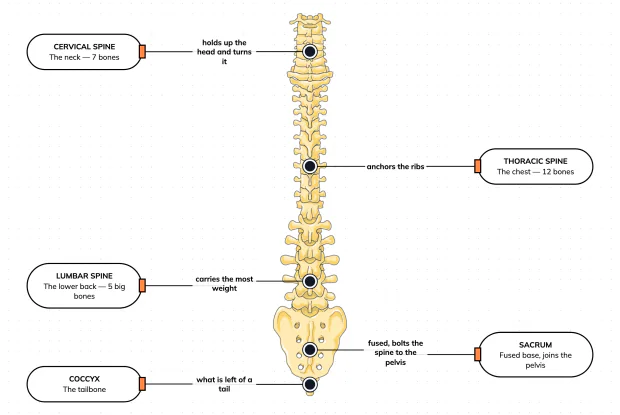
What Are the Main Parts of the Spine?
The spine looks like one bony rod, but it is about thirty-three bones in five regions, each shaped for a different job. Learn the regions of the backbone, then label them yourself in an interactive playground.
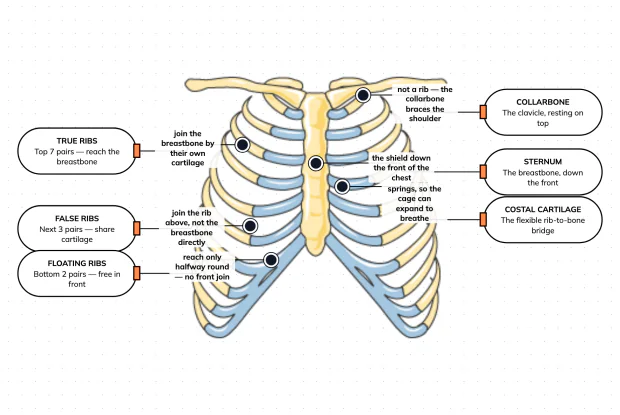
What Are the Parts of the Rib Cage?
The rib cage has to do two opposite jobs: guard the heart and lungs like armour, yet move with every breath. Learn its parts — the breastbone, the springy cartilage, and the true, false and floating ribs — then label them yourself in an interactive playground.
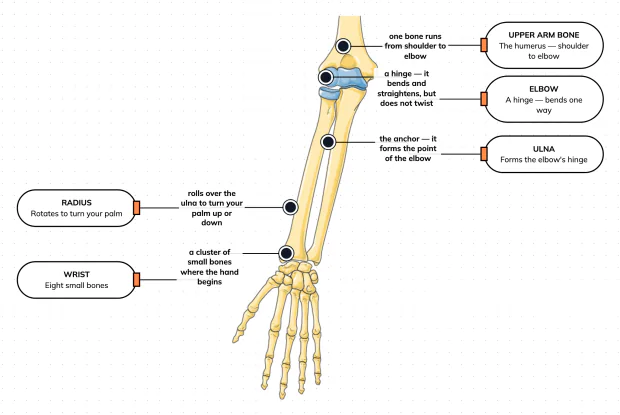
What Are the Bones of the Arm?
The arm is built from one thick bone in the upper arm and two slimmer bones in the forearm, meeting at a hinge. Learn what each bone does — and why the two-bone forearm is what lets you turn your palm — then label them yourself in an interactive playground.
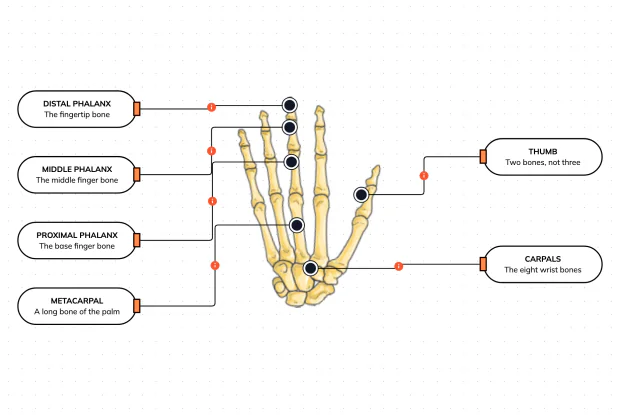
What Are the Bones of the Hand?
The hand packs twenty-seven bones into three neat groups: wrist, palm and fingers. Learn what each group does — and why the thumb has one fewer bone than every finger — then label them yourself in an interactive playground.