How a Bone and a Joint Are Built
Four parts on the machinery before any of it is named. A bone is not the dry stick of a classroom skeleton — it is living tissue with a blood supply, a hard shell and a soft core, and the first part cuts one open. Then a joint, which is the problem of letting two bones move against each other for eighty years without wearing through, and the cartilage and fluid that solve it. The third part adds what actually pulls: muscles work only by shortening, so every movement needs a second muscle to undo the first. The fourth puts all of it on one elbow, where ligaments hold the hinge together and a tendon transmits the pull. Everything in the eleven tracks that follow is made of these four things.
CodePLU Goal
Upgrading Human Mental Models
Learn how to think in Workflows
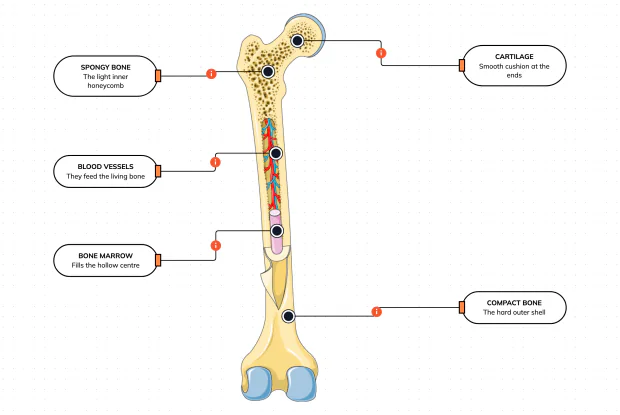
What Is a Bone Made Of?
Cut a bone open and it is nowhere near solid: a hard outer shell, a light honeycomb inside, a hollow centre full of marrow, blood vessels threading through, and a smooth cushion at each end. Learn what each part does — then label them yourself in an interactive playground.
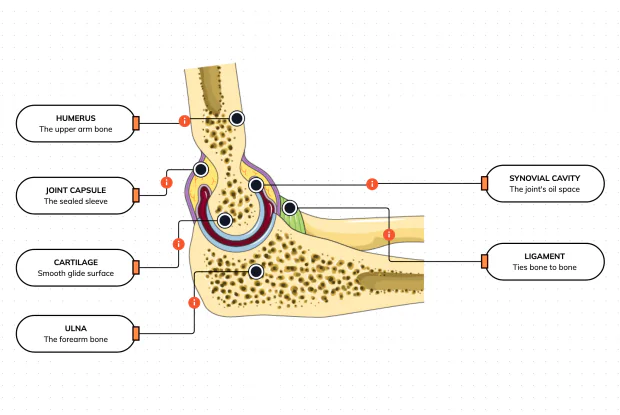
What Is Inside Your Elbow Joint?
A joint is where two bones meet and move — and it is far more than just the bones. Cut open the elbow and you find smooth cartilage caps, a sealed capsule of slippery fluid, and tough ligaments holding it all together. Learn what each part does, then label them yourself in an interactive playground.
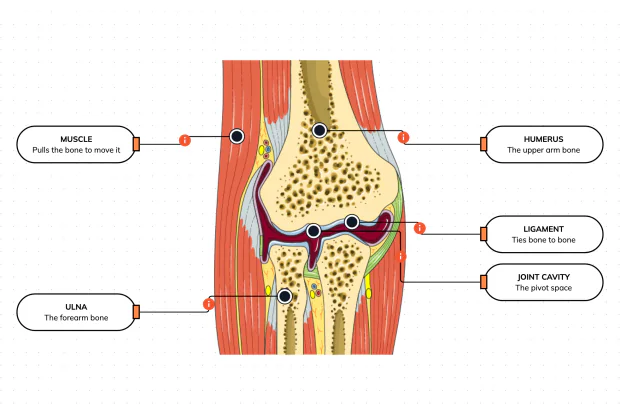
What Makes Your Elbow Bend?
Bones and joints are just the hardware; nothing moves until a muscle pulls. Label the elbow to see the parts that turn a joint into movement — the muscle that pulls, the ligament that holds bone to bone, the two bones it links, and the space they pivot in — then build it yourself in an interactive playground.
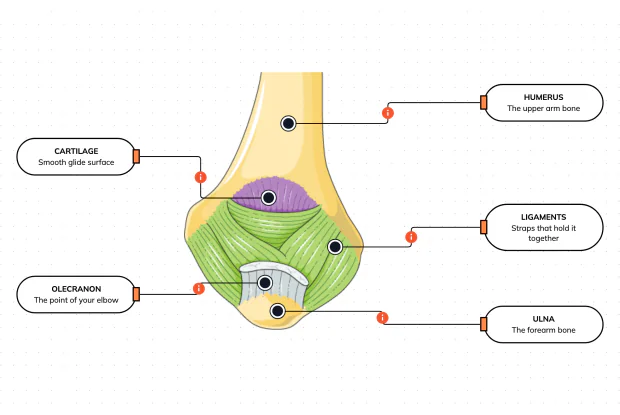
What Holds Your Elbow Together?
Your elbow is pulled on all day — by gravity, by every bag you carry, by every time you hang or push. So what stops the two bones from simply coming apart? Look at the back of the elbow and label the ligaments, the bony point, the cartilage and the two bones — and learn what holds the whole joint together.