Why Do Measurements Need Units?
Root Concept
A measurement is a number plus a unit — without the unit the number cannot be acted on, and with the wrong unit it means something else entirely.
CodePLU Goal
Upgrading Human Mental Models
Learn how to think in Workflows

Concept Development By codeplu.com
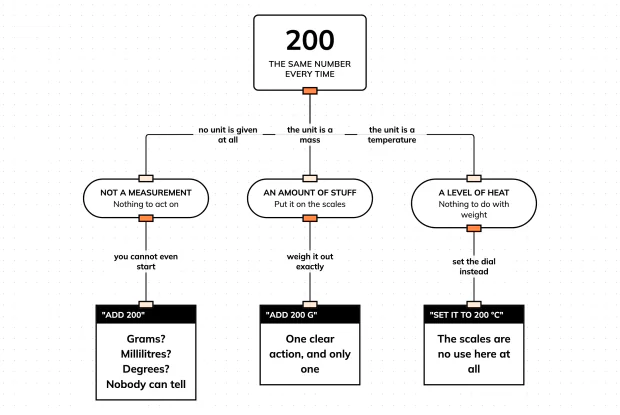
One number with and without units, and what each version lets you do
What Is Missing From the Number 200?
Someone hands you a recipe step that says add 200. Two hundred what? Grams of flour, millilitres of milk, degrees of oven heat — the number is identical in every case and the instruction is unusable until you know which. That gap is the whole point of units.
A measurement is not a number. It is a number plus a unit, and the two parts do different jobs. The number tells you how many, and the unit tells you how many of what. Strip the unit away and the number stops describing anything in the world; it becomes a quantity with no quantity, which cannot be measured out, compared or checked.
This sounds like pedantry and it is the opposite. Missing and mismatched units have destroyed spacecraft, grounded aircraft and caused medical errors, all through arithmetic that was individually correct. In the playground below you will build the number 200 down into three readings and what each one lets you do — including the version that lets you do nothing at all.
What Does a Unit Actually Add?
What are the two parts of a measurement?
Every measurement has a number and a unit, and both are needed. In 200 grams, the 200 counts and the grams says what is being counted — how many of a standard, agreed amount of mass. That word agreed is what makes units work. A gram means the same thing to you, to a shopkeeper and to a laboratory, so a measurement can travel between people and still mean one thing. Before standard units existed, people measured in feet and hands and paces, and those varied by person, which meant a measurement could not be trusted once it left the person who took it. So a unit is really a shared reference. The number says how many references, and everything else about measurement builds on that one idea.
Why is a bare number unusable?
Because you cannot act on it. Take add 200 to a recipe: you cannot put 200 on the scales, since scales measure in grams and there is no way to know whether that was what was meant. You cannot compare it either — is 200 more than 3? Not if the 200 is millilitres and the 3 is litres, because 3 litres is 3000 millilitres. Comparison and arithmetic only work once both quantities are in the same unit, which is exactly why converting matters. The habit worth building is to write the unit every single time, including in your own rough working. It feels unnecessary while the context is in your head, and it is the only thing that protects you three steps later when it is not.
What happens when the units do not match?
This is worse than a missing unit, because nothing looks wrong. If one person records a distance in kilometres and another reads it as miles, both numbers are real, both are correct in their own terms, and the result is silently wrong. In 1999 NASA lost the Mars Climate Orbiter for essentially this reason: one team supplied thrust figures in imperial units while the receiving software expected metric, so the spacecraft approached Mars at the wrong altitude. No arithmetic error occurred anywhere. The misconception worth dropping is that unit errors are careless mistakes made by careless people. They are structural, they survive checking because each side is internally consistent, and the only defence is stating units explicitly at every boundary where information changes hands.
Real World Example
How Did a Unit Mix-Up Nearly Crash an Airliner?
In 1983 an Air Canada Boeing 767 ran out of fuel in mid-flight. Every calculation performed that day was arithmetically correct:
The situation
Canada had recently switched to metric, and the 767 was one of the first aircraft to have its fuel measured in kilograms rather than pounds. The ground crew needed to work out how much fuel to add, and they had a figure for how much was already on board.
The error
A conversion factor for pounds was used where kilograms was required. A kilogram is about 2.2 pounds, so treating one as the other leaves you with roughly half the fuel you calculated. The multiplication itself was performed correctly — the number was right for the wrong unit, which is the hardest kind of error to spot.
The outcome, and the lesson
The aircraft ran out of fuel at altitude and the crew glided it to a landing at Gimli, with no fatalities. The reason this story is told in engineering courses is not the drama: it is that no individual step was wrong. Correct arithmetic on mismatched units produces confident, plausible, wrong answers — which is why the unit has to travel alongside every number it belongs to.
FAQs
Final Words
A measurement is a number plus a unit, and both halves are load-bearing. Without the unit you cannot measure the amount out, compare it to anything or calculate with it. With the wrong unit you get answers that are arithmetically perfect and factually wrong, which is the failure mode that has cost real money and nearly cost lives.
The habit is simple and worth making automatic: write the unit every time, including in rough working, and sanity-check that the units of your answer are the right kind before you look at the number. The next concept turns that into a practical skill — moving between metric units without ever losing track of which way the number should go.
Continue This Track
This concept is part 1 of Measuring and Converting with Confidence.
Why Do Measurements Need Units?
A number on its own is not a measurement. Learn why a missing or mismatched unit makes a figure unusable — and see what each version of 200 actually tells you.
How Do You Convert Between Metric Units?
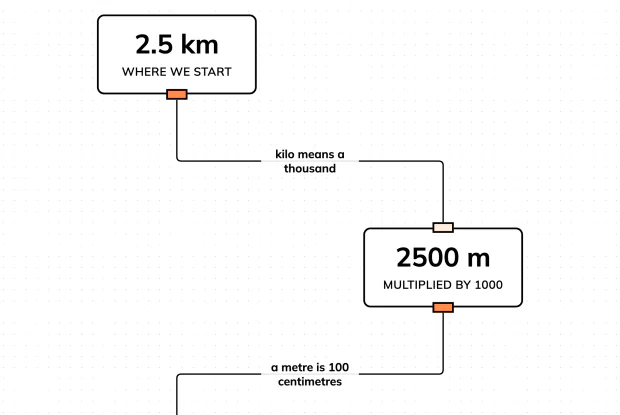
Every metric conversion is multiplying or dividing by a power of ten. Learn the prefixes and the direction check that stops most errors.
How Do You Pick the Right Unit for the Job?
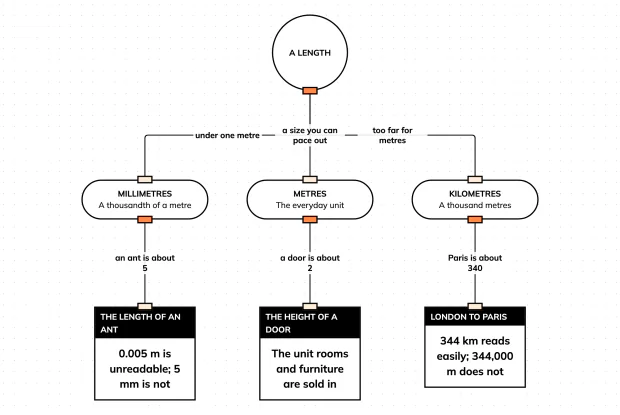
Every unit is technically correct and only one is useful. Learn how to pick the unit that turns an unreadable number into an obvious one.