How Do You Convert Between Metric Units?
Root Concept
Metric units are built on powers of ten, so converting means multiplying or dividing by 10, 100 or 1000 — and moving to a smaller unit always gives a bigger number.
CodePLU Goal
Upgrading Human Mental Models
Learn how to think in Workflows

Concept Development By codeplu.com
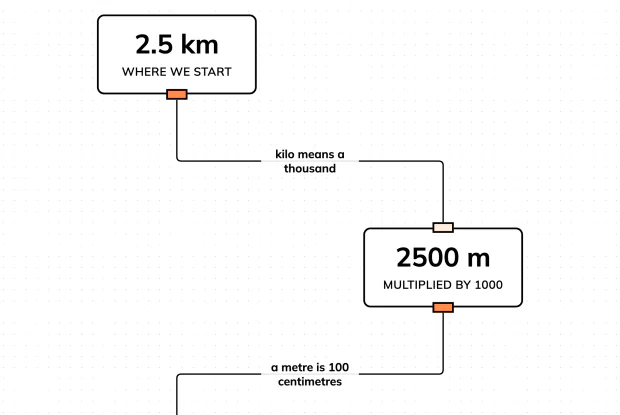
One conversion in two steps, finishing with the direction sense check
Why Is Metric Conversion Just Multiplying by Ten?
The metric system was designed to make conversion easy, and it succeeded so completely that the design is easy to miss. Every metric unit relates to every other by a power of ten — 10, 100, 1000 and so on. That means converting never requires an awkward factor. There is no metric equivalent of remembering that a mile is 1760 yards.
The prefixes carry all the information, and they mean the same thing whatever they are attached to. Kilo always means a thousand, whether it is a kilometre, a kilogram or a kilowatt. Centi always means a hundredth. Milli always means a thousandth. Learn three prefixes and you can convert units you have never met before, which is the real payoff.
There is one thing worth more than the arithmetic, though, and it is a direction check. Converting to a smaller unit must give a bigger number, because it takes more small things to make the same amount. Get the direction wrong and you land a factor of a thousand out, which is the classic conversion error. In the playground below you will convert 2.5 kilometres to centimetres in two steps and finish with exactly that check.
How Does Metric Conversion Work?
What do the prefixes actually mean?
A metric unit name is a prefix plus a base unit. The base units are the plain ones — metre for length, gram for mass, litre for volume — and the prefix scales them. Kilo means one thousand, so a kilometre is a thousand metres and a kilogram is a thousand grams. Centi means one hundredth, so a centimetre is a hundredth of a metre, which is why a metre holds a hundred of them. Milli means one thousandth, so a millilitre is a thousandth of a litre, and a litre holds a thousand. The power of this is that the prefixes are universal. If you meet a kilojoule or a millisecond having never seen either before, you already know one is a thousand joules and the other is a thousandth of a second. Three prefixes cover the overwhelming majority of everyday measurement.
Which way round do you multiply?
Going to a smaller unit, multiply. Going to a bigger unit, divide. The reason is worth holding on to rather than memorising: a smaller unit is a smaller step, so you need more of them to cover the same distance. Converting 2.5 kilometres to metres means going to a smaller unit, so multiply by 1000 to get 2500 metres — a bigger number for the same distance. Converting 2500 metres back to kilometres means going to a bigger unit, so divide by 1000. In place-value terms multiplying by 1000 shifts every digit three columns left, which is precisely the same machinery as decimals and percentages. If the metric system feels easy, it is because it was built to sit on top of place value rather than fight it.
How do you do a two-step conversion?
Sometimes there is no direct prefix relationship, and the fix is to go via the base unit. To convert 2.5 kilometres to centimetres, first go to metres by multiplying by 1000, giving 2500 metres, then go to centimetres by multiplying by 100, giving 250 000 centimetres. Two clean steps beat trying to recall a single factor of 100 000. Routing through the base unit is worth making a habit, because it works for units you have never converted before and it keeps each step small enough to check. Now the misconception this section exists to kill: many people learn conversion as counting decimal-point moves. It gets the right answer and it teaches nothing, so when a two-step conversion appears there is nothing to fall back on. Multiplying by the factor you can name is slower to write and far harder to get wrong.
Why is the direction check worth more than the arithmetic?
Because direction is where the real errors live. Multiplying instead of dividing by 1000 puts you out by a factor of a million, and the number will look perfectly plausible on the page. So before accepting any conversion, ask whether the answer should be bigger or smaller than what you started with. 2.5 kilometres becoming 250 000 centimetres passes, because centimetres are far smaller than kilometres so the count must be far larger. If you had got 0.000025, the direction alone tells you something is wrong without checking a single digit. This is the same class of habit as substituting back into an equation: a cheap independent test that catches the errors your main method cannot see.
Real World Example
How Much Water Does the Recipe Actually Need?
Kitchen measurements are where most people meet unit conversion, and where the direction error is easiest to make:
The problem
A recipe calls for 1.5 litres of stock. Your measuring jug is marked only in millilitres. Milli means one thousandth, so a litre contains a thousand millilitres, and you are going to a smaller unit — which means multiply. 1.5 times 1000 gives 1500 millilitres.
The error that feels right
Divide instead of multiplying and you get 0.0015 millilitres. That is a factor of a million out, and it is a genuinely easy slip if you are counting decimal moves rather than thinking about size. The number looks like a real measurement, which is why it survives a quick glance.
The check that catches it
A millilitre is much smaller than a litre, so the count must be much bigger than 1.5 — and 0.0015 is much smaller, so it fails immediately. 1500 passes. It also passes a common-sense test: 1500 millilitres is one and a half of those large bottles, which is about right for a pan of stock. Two checks, three seconds, and no need to re-do any arithmetic.
FAQs
Final Words
Metric conversion is multiplying or dividing by a power of ten, and the prefixes tell you which power. Kilo is a thousand, centi is a hundredth, milli is a thousandth, and they behave identically on any base unit — which is why three prefixes let you convert units you have never seen.
The direction check is the part worth keeping forever: going to a smaller unit gives a bigger number. It costs a second, needs no arithmetic, and catches the factor-of-a-thousand slips that a recalculation often repeats. The final concept in this category is about choosing well in the first place — because the right unit turns an unreadable number into an obvious one.
Continue This Track
This concept is part 2 of Measuring and Converting with Confidence.
Why Do Measurements Need Units?
A number on its own is not a measurement. Learn why a missing or mismatched unit makes a figure unusable — and see what each version of 200 actually tells you.
How Do You Convert Between Metric Units?
Every metric conversion is multiplying or dividing by a power of ten. Learn the prefixes and the direction check that stops most errors.
How Do You Pick the Right Unit for the Job?
Every unit is technically correct and only one is useful. Learn how to pick the unit that turns an unreadable number into an obvious one.