How Do You Pick the Right Unit for the Job?
Root Concept
The right unit is the one that gives a number you can hold in your head — and it must always match the quantity you are measuring.
CodePLU Goal
Upgrading Human Mental Models
Learn how to think in Workflows

Concept Development By codeplu.com
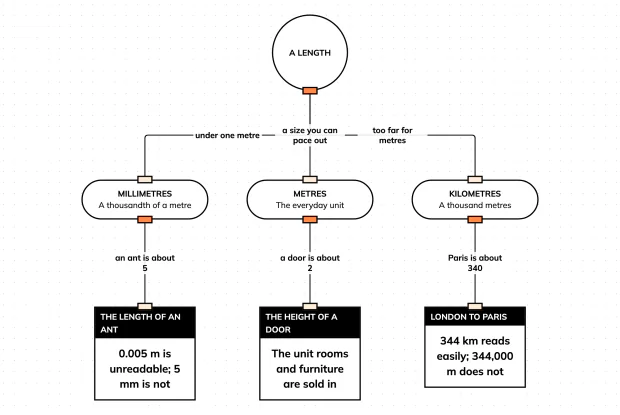
A length branches into three units, each with something of that size
If Every Unit Is Correct, Does the Choice Matter?
The distance from London to Paris is about 400 kilometres. It is also about 400 000 metres, and about 400 000 000 millimetres. All three are true, and two of them are useless. Nobody can look at 400 000 000 and feel anything about it, which is the entire problem with choosing a unit badly.
So the choice is not about correctness, it is about readability. A good unit gives you a number small enough to hold in your head and large enough not to disappear into decimal places — roughly speaking, somewhere between about 0.1 and 1000. Below that you are counting zeros after a point; above it you are counting digits. Either way you have stopped understanding the size and started decoding it.
There is a second and more absolute rule sitting underneath. The unit has to match the quantity: you can measure a length in millimetres or kilometres, but never in grams, because grams measure a different kind of thing altogether. Get the size wrong and your number is awkward. Get the kind wrong and your number is meaningless. In the playground below you will build a length down into the three units, and each unit down to something that size.
How Do You Choose Well?
Why does the choice of unit matter if they are all correct?
Because numbers are for people, and people are bad at very long ones. Compare a road described as 2 kilometres long with the same road described as 2 000 000 millimetres. Both are accurate. Only one lets you picture a walk. Long strings of digits also invite errors — miscount the zeros once and you are out by a factor of ten, and nobody reviewing the figure will notice. A well-chosen unit is therefore a form of error prevention as well as a courtesy. This is worth saying plainly because school questions often accept any correct unit, which quietly teaches that the choice does not matter. Outside school it matters constantly: every engineer, nurse and builder picks units to make the numbers in front of them hard to misread.
How do you pick the right size of unit?
Aim for a number you can say out loud without counting digits — as a rough guide, between about 0.1 and 1000. Work out roughly how big the thing is, then choose the unit that lands your figure in that window. An ant is a few millimetres, so millimetres it is; in metres it would be 0.005, which tells you nothing. A door is about two metres, comfortably in range. The distance to Paris is hundreds of kilometres, which fits, whereas metres would give six digits. A practical shortcut is to think about what people who deal with the thing daily actually use. Tailors use centimetres, road signs use kilometres, pharmacists use millilitres. Those conventions exist because someone already solved this problem for that scale.
Why can't you swap one kind of unit for another?
Because different units measure different quantities, and no conversion factor connects them. Length is measured in metres and their relatives; mass in grams; volume in litres; time in seconds. Asking how many grams long a table is has no answer — not a hard one, but no answer at all, because the question mixes two unrelated properties. This is the one measurement rule with no flexibility in it, and it is also a useful checking tool. If a calculation produces the wrong kind of unit, the method was wrong regardless of the arithmetic. Divide a distance by a time and you should get a speed; if your units come out as something else, stop and look at the method rather than the numbers. The trap worth naming is volume and mass: a litre of water happens to weigh about a kilogram, which makes them feel interchangeable, and for oil or flour that relationship does not hold at all.
Real World Example
Why Does a Hospital Insist on Millilitres?
Unit choice looks like a matter of taste until the cost of a misread number goes up:
The dose in litres
A child needs 0.0025 litres of a medicine. That is correct and nearly unreadable — the information lives in the zeros, and losing or gaining one changes the dose by a factor of ten. Anybody reading it quickly, under pressure, is being asked to count decimal places accurately.
The same dose in millilitres
Written as 2.5 millilitres it becomes something a person can hold in their head, check against a syringe and repeat back to a colleague. Nothing about the quantity changed. The unit was chosen to put the number in a range where human beings are reliable, which is why medicine uses millilitres and milligrams almost universally.
The unit that is not an option
Now suppose someone wrote 2.5 milligrams instead. Millilitres measure volume and milligrams measure mass, so this is not a rounding issue or a bad choice — it is a different quantity, and for a liquid medicine the two are not interchangeable. Choosing the wrong size of unit makes a number awkward. Choosing the wrong kind makes it wrong.
FAQs
Final Words
Every unit of the right kind is correct, and only some are useful. Choose the one that puts your number in a range a person can read — roughly 0.1 to 1000 — because long strings of digits and zeros are where misreadings live. When in doubt, use what people who work at that scale already use.
Underneath that sits the rule with no exceptions: the unit must match the quantity. Length cannot be measured in grams, and a calculation producing the wrong kind of unit has gone wrong in its method, not its arithmetic. That check — look at the kind of unit before the number — is the most portable thing in this whole category.
Continue This Track
This concept is part 3 of Measuring and Converting with Confidence.
Why Do Measurements Need Units?
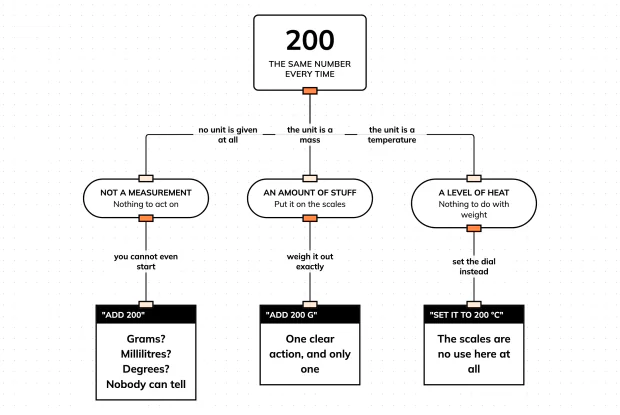
A number on its own is not a measurement. Learn why a missing or mismatched unit makes a figure unusable — and see what each version of 200 actually tells you.
How Do You Convert Between Metric Units?
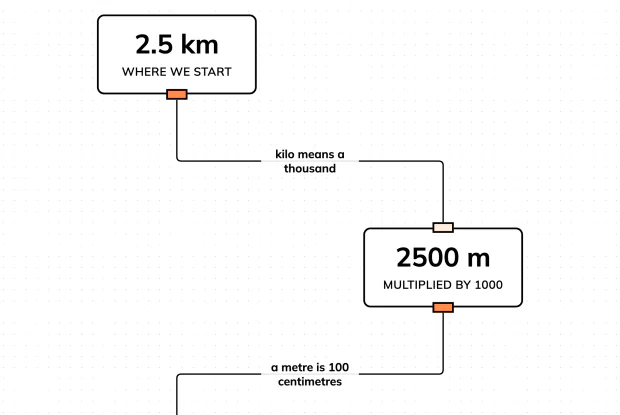
Every metric conversion is multiplying or dividing by a power of ten. Learn the prefixes and the direction check that stops most errors.
How Do You Pick the Right Unit for the Job?
Every unit is technically correct and only one is useful. Learn how to pick the unit that turns an unreadable number into an obvious one.