What Does a Battery Actually Do?
Root Concept
A battery holds a chemical store and uses it to push charge around a circuit; when it goes flat the chemicals are exhausted, so the push stops — the charge was never the thing being used up.
CodePLU Goal
Upgrading Human Mental Models
Learn how to think in Workflows

Concept Development By codeplu.com
What a battery supplies is a push — and what runs out is the chemistry behind it
If a Battery Does Not Store Electricity, What Is In It?
Chemicals. That is the honest answer, and it is stranger than the usual one. A battery is a sealed container of substances that are able to react with each other, arranged so that the only way the reaction can proceed is by pushing charge out through one end and taking it back in at the other. No electricity is stored in there waiting to be poured out.
This matters because the everyday picture — a battery as a tank of electricity that slowly empties — makes several later ideas impossible to understand. It suggests a flat battery has run out of charge, which is wrong. It suggests electricity is a substance you can have a quantity of, which the first part of this track already ruled out: nothing holds a store of electricity, because electricity is a flow, not a stuff.
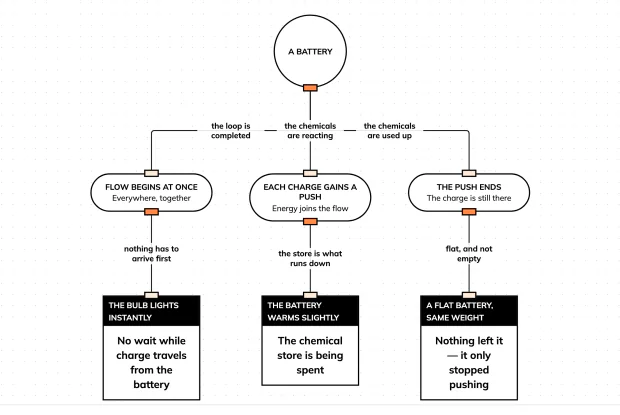
What a battery genuinely provides is a push. In the playground below you will build a battery down to what it does at each moment, and the third pair is the one worth getting right: when the chemicals are finally spent, what stops is the pushing. Every bit of charge that was ever in that circuit is still sitting exactly where it was.
How Does a Battery Do Its Job?
What is a battery actually storing?
A chemical store, in the sense used earlier in this track. Two different materials sit inside, separated so they cannot simply react and be done with it. Each material would rather give up or take on electrons than stay as it is, and the battery's design makes the only available route for those electrons the long way round — out through the terminal, through your circuit, and back in the other end. So the reaction is held hostage to the circuit: complete the loop and the chemistry can proceed, break the loop and it largely stops. That is why a battery sitting in a drawer with nothing attached stays useful for years. It is not leaking electricity, because it never had any. It is a reaction waiting for permission, and the closed loop is the permission.
What does giving charge a push actually mean?
It means handing energy to each bit of charge that passes through. The formal name for the size of that push is voltage, and a 1.5 volt cell pushes each unit of charge about a tenth as hard as a 15 volt supply would. A useful way to hold it: current is how much charge is flowing, and voltage is how hard each bit of it is being shoved. Those are genuinely different quantities, and mixing them up is behind most confusion about electricity. A car battery and a small torch cell can both be around 12 to 1.5 volts respectively, yet the car battery can deliver enormous current — a hard shove given to a great deal of charge at once. The bulb in your circuit does not care where the push came from. It only experiences charge arriving with energy and leaving with less.
So what has run out when a battery is flat?
The chemicals have been converted into their reacted forms, and there is nothing left that wants to react. No push, so no flow, so nothing lights. Notice what has not happened: no charge has been lost, no electrons have escaped, and the battery has not become lighter in any way you could weigh. It contains exactly the same atoms it started with, rearranged. This connects straight back to the conservation idea from the first track. The energy that was in the chemical store has not vanished either — it went out through the circuit, became light and heat at the bulb, and spread into the room where it is far too thinly distributed to gather up again. The battery is not empty. It is finished.
Real World Example
Why Does a Flat Battery Weigh the Same as a Fresh One?
Weigh a new AA cell on a sensitive balance, run it flat in a torch, and weigh it again. Nothing measurable has changed:
The mass is the same
Every atom that was sealed inside is still sealed inside. Nothing was poured out, because there was never a substance called electricity in there to pour.
The contents have rearranged
The two materials have reacted into new combinations. That is the entire difference between full and flat.
The energy is genuinely gone from it
It left through the wires, became light and heat, and is now spread thinly through the room — still in existence, just far too dilute to use.
Why a rechargeable one can go again
Pushing current backwards through it forces the reaction to run in reverse, restoring the original materials. You are not refilling it with electricity; you are rewinding the chemistry.
FAQs
Final Words
A battery is a held-back chemical reaction with a very specific condition attached: it can only proceed if charge is allowed to travel out of one end, round a loop, and back into the other. What it supplies to that loop is a push, measured in volts, handed to every bit of charge that passes. What it never supplies is electricity, because electricity is not the kind of thing that can be kept in a box.
That is why a flat battery weighs the same as a fresh one, why the cold makes a good battery act like a dying one, and why a battery attached to nothing will still be useful next year. Together with the closed loop and the free-to-move test, you now have the three ideas the whole of basic circuits is built from — enough to make sense of what changes when you start adding more than one bulb.
Continue This Track
This concept is part 3 of What Makes a Circuit Work.
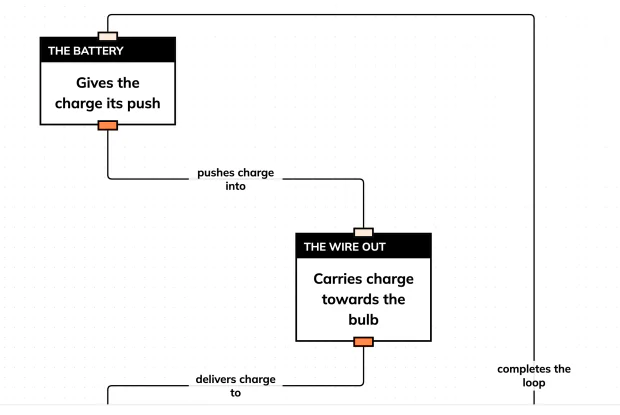
Why Must an Electric Circuit Be a Complete Loop?
A bulb lights only when charge has an unbroken path back to the battery. Build that loop yourself and find out exactly what one small break does.
What Lets Electricity Through, and What Blocks It?
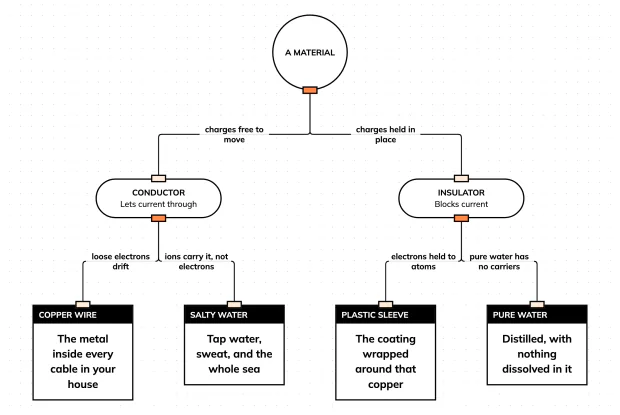
Conductors and insulators are not about what a material is made of but about whether anything inside it is free to move. Sort four materials by that test.
What Does a Battery Actually Do?
A battery does not store electricity waiting to be used up. It holds chemicals, and it pushes. Build a battery down to what it does at each moment.