What Are the Parts of a Plant, and What Does Each One Do?
Root Concept
A plant is four parts with four jobs — take in water, carry it, catch light, make seeds — and each part sits exactly where its job requires.
CodePLU Goal
Upgrading Human Mental Models
Learn how to think in Workflows

Concept Development By codeplu.com
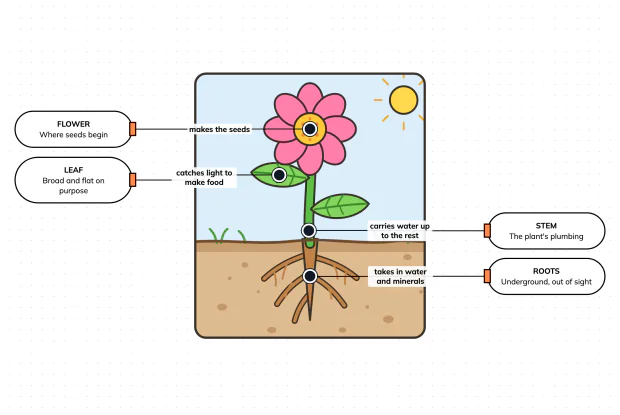
Each part of a plant, joined to the place its job requires it to be
Why Does a Plant Need Four Different Parts?
A plant has a problem you never think about: everything it needs is in two completely different places. Water and minerals are in the soil, underground and in the dark. Light is in the air, above the ground. Nothing can be in both places at once, so a plant cannot be one simple thing. It has to be built out of parts, and each part has to sit where its own job is possible.
That is really all the four parts are. Roots go down, because water is down. Leaves go out and up, because light is up. The stem exists because those two jobs happen far apart and something has to join them. And the flower sits at the top, where it is easiest to find, because its job is not feeding the plant at all — it is making the next one.
Once you see the parts as four answers to four problems, their positions stop being something to memorise. A root at the top of a plant would be useless; a flower buried in soil would never be found. In the playground above you will label a plant yourself, and the label on each connection is the job that part does — so you are learning what each part is for at the same time as where it goes.
What Does Each Part of a Plant Actually Do?
What do the roots do besides hold the plant up?
Roots do two jobs at once, and most people only know the first. They anchor the plant, which is why a tree survives wind that would knock you over. But their main work is drinking: water and dissolved minerals are pulled in through thousands of tiny root hairs, far too small to see. Those hairs are the reason a root system is so much bigger than it looks — spreading wide gives it more surface to absorb through. Many beginners think roots take in food. They do not. They take in water and minerals; the food is made somewhere else entirely, which is the point of the next part.
Why is a leaf flat instead of round?
A leaf is the part that makes food, and its shape is a direct consequence of that job. It uses light, and light falls on surfaces — so the more surface a leaf turns towards the sun, the more light it catches. That is why leaves are broad and flat rather than compact: flatness is not decoration, it is the whole design. Inside, the leaf combines water from the roots with carbon dioxide from the air and uses light energy to build sugar. This is photosynthesis, and it means the plant is not fed from the soil like an animal at a bowl — it feeds itself, from the air and the light.
What is the stem for, if it does not make anything?
The stem makes nothing, and it is essential anyway. Water arrives at the roots and is needed at the leaves; sugar is made in the leaves and is needed everywhere, including back down at the roots. Something has to carry both, in both directions, and that is the stem. It is plumbing. It also does a second job that is easy to miss: it holds the leaves up and spreads them out so they do not shade each other. A plant whose leaves all sat at ground level would shade itself and starve, however healthy each individual leaf was.
Why is the flower at the top?
The flower is the only part not working to keep this plant alive — its job is the next plant. It makes seeds, and to do that most flowers need pollen carried to them by an insect, a bird or the wind. So the flower has to be found. Being at the top makes it visible and reachable, and the bright petals and scent are advertising aimed at whatever will do the carrying. Once you know the job, the position explains itself — a flower hidden under the leaves would be a flower nobody visits.
Do all plants have all four parts?
No, and the exceptions are worth knowing because they prove the parts are jobs rather than rules. Mosses have no true roots and no flowers. Ferns have roots, stems and leaves but make spores instead of seeds, so they never flower. A cactus has leaves reduced to spines and does its food-making in a swollen green stem instead, because in a desert a broad flat leaf loses too much water. In each case the job still has to be done — something still absorbs, something still makes food — but a different part has taken it on.
Real World Example
Why Does a Cut Flower Die but a Cutting Sometimes Grow?
Put a cut rose in water and it lasts a week. Put a cut mint stem in water and it grows roots. The difference is which parts are present, and which ones can be rebuilt:
The cut rose
Flower and stem, no roots
The flower is already made and cannot be undone. The stem can draw a little water straight up, which is why the bloom stays fresh for days — but nothing is absorbing minerals and nothing new is being built. It is running down a battery.
The mint cutting
Stem and leaves, no flower
The leaves keep making food, and a stem in water can grow new roots from the cut end. Once those roots appear the plant has all four jobs covered again and it carries on as a whole plant.
What this tells you
The parts are jobs
A cutting works when the parts that remain can rebuild the parts that are missing. That is only possible because each part is doing a job, not simply occupying a position.
FAQs
Final Words
A plant is four parts because it has four problems: water is underground, light is overhead, the two are far apart, and the next generation has to be made and found. Roots absorb, leaves make food, the stem carries and lifts, the flower makes seeds. Every position follows from a job.
That is why the exceptions make sense rather than breaking the rule. A cactus with no real leaves, a fern with no flower, a potato that is a stem in disguise — in each case the job is still being done, just by a different part. Learn the four jobs and you can work out any plant you meet.
Continue This Track
This concept is part 1 of How a Plant Is Built, and What Each Part Is For.
What Are the Parts of a Plant, and What Does Each One Do?
A plant is not one thing doing one job — it is four parts, each solving a different problem. Learn what roots, stem, leaf and flower each do, then label a plant yourself in an interactive playground.
What Are the Parts of a Flower, and How Do They Make a Seed?
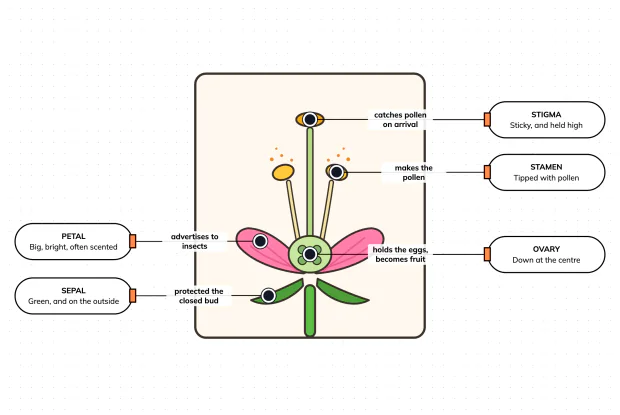
A flower is not decoration — it is the part of a plant whose job is the next plant. Learn what the petal, sepal, stamen, stigma and ovary each do, then label a flower yourself in an interactive playground.
How Does a Seed Become a Plant?
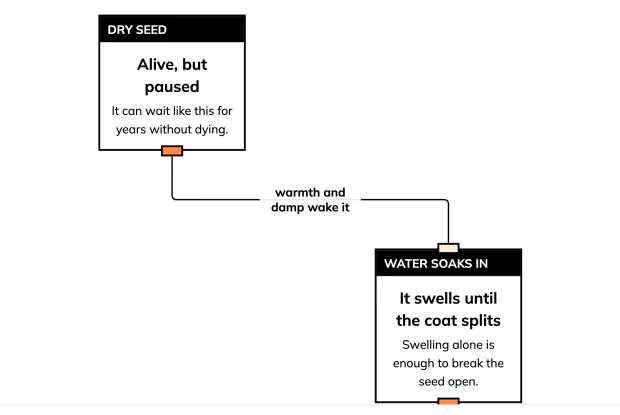
A seed sits doing nothing for months, then grows in total darkness without being fed. Learn the five steps of germination, and why the root always goes down before the shoot goes up, then build the sequence yourself in an interactive playground.