What Are the Parts of a Flower, and How Do They Make a Seed?
Root Concept
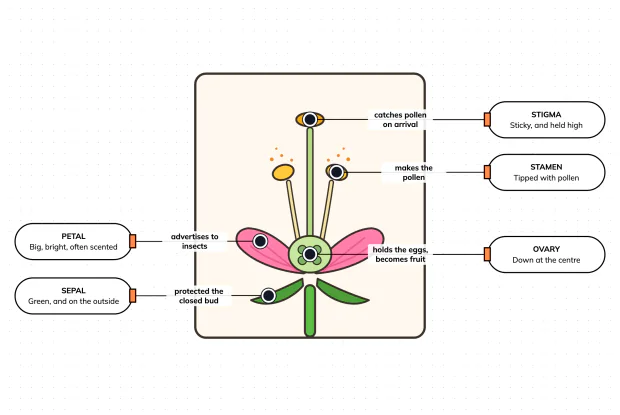
A flower is a seed-making machine: one part advertises, one protected the bud, one makes pollen, one catches it, and one turns the result into seeds.
CodePLU Goal
Upgrading Human Mental Models
Learn how to think in Workflows

Concept Development By codeplu.com
Each part of a flower, joined to the job it does in making a seed
Why Does a Flower Have So Many Different Parts?
A flower looks like the part of a plant that is there to be admired. It is actually the part with the most difficult job of all: making the next plant. And it has to do that job with a serious handicap — a plant cannot walk. It cannot go looking for a partner the way an animal can. So the plant stays put, and the pollen has to travel instead.
Everything a flower is made of follows from that one problem. Something has to produce the pollen, which is the stamen. Something has to get it noticed and carried, which is what the bright petals are for. Something has to catch it when it arrives, which is the stigma. Something has to turn what arrives into seeds, and that is the ovary. And before any of this could happen, the whole delicate bundle had to survive as a bud — which is what the sepals were doing while you were not looking.
So the five parts are five steps in one process, not five decorations. In the playground above you will label a flower yourself, and the label on each connection is the job that part does — so you are learning what each part is for at the same time as where it sits.
What Does Each Part of a Flower Actually Do?
Why are petals so big and brightly coloured?
Petals are advertising. Colour, scent and a reward of sugary nectar are all aimed at whatever the flower needs to carry its pollen — a bee, a butterfly, a moth, sometimes a bird. The flower is paying for a delivery service, and the petal is the shop sign. The proof is what happens when no delivery is needed: grasses, wheat and many trees are pollinated by the wind, and their flowers are tiny, green and easy to miss entirely. Nobody needs convincing to blow, so nothing is spent on convincing. Many beginners assume petals exist because flowers are beautiful. It is the other way round — flowers look beautiful to us because they evolved to be noticed.
What is a sepal, and why do we hardly ever notice one?
Sepals are the small green parts just underneath the petals, and they are easy to miss because their work is already finished by the time you see the flower. Before it opened, the flower was a bud, and the sepals were the wrapping — holding the soft, unfinished petals and stamens closed against rain, cold and hungry insects. Look at a rose bud and you can see them still gripping it shut. Once the flower opens, they fold back and stay there. They look like little leaves, and they are made of similar stuff, but a leaf makes food and a sepal guards a bud. Same appearance, different job.
Where does pollen actually come from?
From the stamen. A stamen is a thin stalk with a swollen tip: the tip is called the anther, and it is where the pollen is made. When it is ready, the anther splits open and the pollen is exposed as a fine powder — which is what ends up on your fingertip if you touch a lily. Each grain of pollen carries half the instructions for a new plant. That is why pollen matters so much and why there is so much of it: most grains never reach anything, so the flower makes far more than it needs. Pollen is not seed, and it is not dust or dirt. It is one half of the recipe, waiting for the other half.
How does pollen get to the right place?
The target is the stigma — the tip of the flower's central column, usually sticky or slightly rough so that pollen sticks on contact instead of blowing off again. Notice where it is: held up on a stalk called the style, often higher than everything else in the flower. That is deliberate. An insect climbing in for nectar has to brush past it. When pollen lands there, that is pollination — the delivery. It is not yet the making of a seed. Many flowers hold the stigma above their own anthers, which makes it a little more likely that the pollen arriving came from a different flower, and a mix of two parents is usually a stronger start.
What happens inside the ovary?
The ovary is the rounded base of that central column, and inside it are the eggs, called ovules. Once a pollen grain is stuck on the stigma, it grows a microscopic tube down through the style and into the ovary, and delivers its half of the instructions to an egg. That joining is fertilisation, and it is the moment a seed begins. Then something surprising happens: the ovary itself starts to swell. It thickens, fills with sugar and water, and becomes the fruit. This is the part almost everyone has backwards — the fruit is not a container that seeds were later placed inside. The fruit is the ovary, grown up.
Real World Example
Why Are the Seeds in the Middle of an Apple?
An apple is not a box that someone put seeds into. It is the ovary of an apple blossom, swollen up around the seeds it made. Every part of the old flower is still findable if you know what to look for:
The pips in the core
Fertilised ovules
Each pip was one egg sitting inside the ovary, and each one only became a seed because a pollen grain reached it. Count the pips and you are counting successful deliveries. An apple that grew lopsided usually had eggs on one side that were never fertilised at all.
The flesh you eat
The swollen ovary wall
All of that sweetness is the ovary itself, thickened after fertilisation. The tree spends real sugar building it, and not for our benefit — it is paying an animal to carry the seeds somewhere new. The apple is a bribe with a job attached.
The little brown star
Dried sepals and stamens
Turn an apple upside down, opposite the stalk, and there is a small dry crown. Those are the shrivelled remains of the sepals and stamens of the flower it used to be, still attached months later. It is the easiest way to prove all of this in your own kitchen.
FAQs
Final Words
A flower has five parts because making a seed takes five different jobs, and a plant that cannot move has to do all of them in one place. The stamen makes the pollen, the petal buys it a ride, the stigma catches what arrives, the ovary turns it into seeds and then into fruit, and the sepal kept the whole arrangement safe until it was ready to open.
Once you can name the parts by their jobs, flowers stop looking decorative and start looking engineered. And the next apple you cut open stops being a snack and becomes the evidence: pips that were eggs, flesh that was an ovary, and a small brown star that used to be a ring of sepals.
Continue This Track
This concept is part 2 of How a Plant Is Built, and What Each Part Is For.
What Are the Parts of a Plant, and What Does Each One Do?
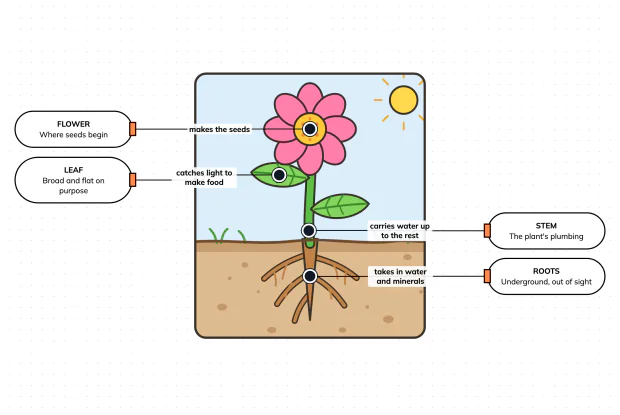
A plant is not one thing doing one job — it is four parts, each solving a different problem. Learn what roots, stem, leaf and flower each do, then label a plant yourself in an interactive playground.
What Are the Parts of a Flower, and How Do They Make a Seed?
A flower is not decoration — it is the part of a plant whose job is the next plant. Learn what the petal, sepal, stamen, stigma and ovary each do, then label a flower yourself in an interactive playground.
How Does a Seed Become a Plant?
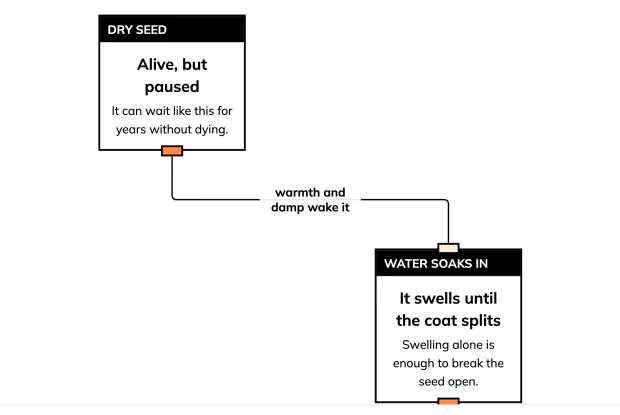
A seed sits doing nothing for months, then grows in total darkness without being fed. Learn the five steps of germination, and why the root always goes down before the shoot goes up, then build the sequence yourself in an interactive playground.