How Does a Seed Become a Plant?
Root Concept
A seed already carries its own food, so the first thing it needs is not light but water — which is why the root always grows down before the shoot grows up.
CodePLU Goal
Upgrading Human Mental Models
Learn how to think in Workflows

Concept Development By codeplu.com
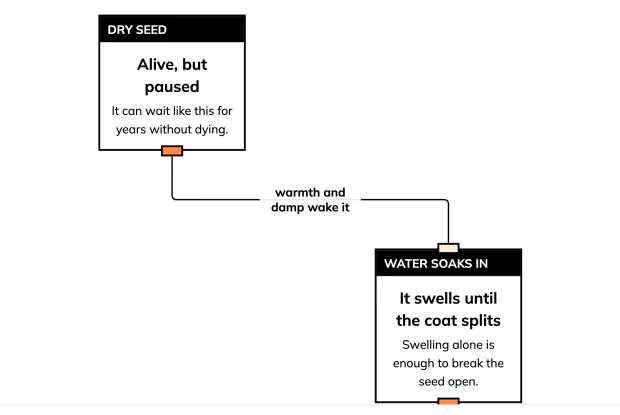
The five steps of germination, each connection carrying the reason the next one follows
Why Does a Seed Need Nothing but Water to Start?
A seed is one of the strangest things in biology: it is completely alive and doing almost nothing. A packet of bean seeds in a drawer is not a box of dead objects waiting to be brought to life. Each one is already living, just paused — running so slowly that it can sit there for years, and in some species for centuries, and still start growing when the moment comes.
What restarts it is water. Not light, not soil, not feeding — water, with some warmth and air. That surprises people, but it makes sense once you notice what a seed already has: packed inside it is a food store, put there by the parent plant. A seed is a baby plant with a lunch already made. It does not need feeding. It needs a drink.
That one fact decides the order of everything that follows, including the step almost everybody gets the wrong way round. In the playground above you will build the sequence yourself, and each connection carries the reason the next step happens — so you are not memorising an order, you are working out why it could not be any other order.
What Happens Inside a Seed, Step by Step?
What is a seed doing while it sits in the packet?
Almost nothing — on purpose. A dry seed contains very little water, and without water the chemistry of life runs at a crawl. This state is called dormancy, and it is a survival trick rather than an accident: a seed that can wait is a seed that can survive a winter, a drought or a journey inside an animal, and start only when conditions are worth starting in. Many beginners picture a seed as inactive material that water somehow brings to life. It was alive the whole time. Water does not create the life in a seed; it unpauses it.
Why is water the trigger?
Water does two jobs at once. First, it makes the seed swell — and a swelling seed generates real force, enough to split its own tough outer coat from the inside. That crack is the doorway everything else comes out of. Second, water lets the chemistry restart: the food packed inside a seed is stored in a form that cannot be used as it is, and only in water can it be broken down into something the growing parts can actually spend. So water is both the crowbar and the switch. Warmth and air matter too, but water is what nothing else can substitute for.
Why does the root grow down before the shoot grows up?
This is the step most people guess wrong, and the reason is worth sitting with. A seedling has food but no water supply, and it has just used water to wake up. If it spent its energy reaching for light first, it would run dry before it ever got there. So it solves the shortage first: the root comes out of the split coat and grows downwards, anchoring the seedling and starting to drink. Only then can it afford to climb. And the root does not go down by luck — a root can sense which way gravity pulls, which is why a seed dropped into soil at any angle still sends its root down and its shoot up.
How does a shoot grow underground with no light at all?
On its packed lunch. The food store the parent plant put into the seed is what pays for every bit of growth until the first leaves reach daylight, which is why a seed can be buried and still make it out. You can see the evidence in the colour: a shoot that has not yet met light is pale cream or yellow, not green, because green needs light to develop. It also grows unusually long and thin, stretching as far as it can on a fixed budget. That is a seedling gambling its whole inheritance on the surface being close enough.
Why does it matter how deep a seed is planted?
Because the food store is a fixed budget and the climb is what it has to pay for. A seed buried too deep can do everything right and still run out of food a few centimetres short of daylight, and there is no way to top it up — nothing is feeding it. That is why seed packets give a depth, and why the depth is smaller for smaller seeds: a tiny seed carries a tiny lunch, so lettuce goes in barely covered while a broad bean can go a knuckle deep. Those two thick pale halves you see on a bean seedling are the lunch itself. They are called cotyledons, and their shrivelling is a receipt for a journey that was paid for in full.
When does the seedling stop depending on the seed?
At the moment its first proper leaves open in the light. Then the seedling starts making its own food out of light, water and air, and the store inside the seed — which by now is nearly spent — stops mattering. This is the real finish line of germination: not the moment the plant appears above ground, but the moment it stops living on its inheritance. Watch a bean seedling and you can see the handover happen. The two thick pale halves that came up with it shrivel and drop off, because the job they existed to do is over.
Real World Example
What a Bean on Wet Cotton Wool Shows You in Four Days
Put a bean on damp cotton wool in a jar on a windowsill and check it once a day. No soil, no plant food, nothing added but water. What you see proves two of the claims above better than any diagram:
Day one: only water has changed
The bean swells and splits
The skin wrinkles, then tightens, then breaks along one side. Nothing has been fed to it and nothing has been buried. Swelling alone opened it, which is the whole of step two happening in front of you.
Day two: a white root, downwards
Before anything green appears
A pale root emerges from the split and turns down — not towards the window, down. Turn the jar on its side and come back a few hours later: the root has re-aimed downwards again. It is answering gravity, not light.
Day four: pale first, then green
Colour arrives only with light
The shoot comes up cream-coloured and greens over the following day. That colour change is the proof that everything before it was paid for by the seed, not by sunlight — the shoot was built in the dark and only started earning once it was out.
FAQs
Final Words
Germination looks like a plant appearing out of nothing, and it is really a plant spending an inheritance. The parent packed a lunch into the seed; water unpauses the seed and splits it open; the root goes down first because water is the thing the seedling does not have; the shoot climbs on borrowed food; and the moment the first leaves open in the light, the borrowing stops.
That is also why the order cannot be rearranged. Every step is paid for by the one before it, and the step everybody guesses wrong — down before up — is the one that makes all the others affordable.
Continue This Track
This concept is part 3 of How a Plant Is Built, and What Each Part Is For.
What Are the Parts of a Plant, and What Does Each One Do?
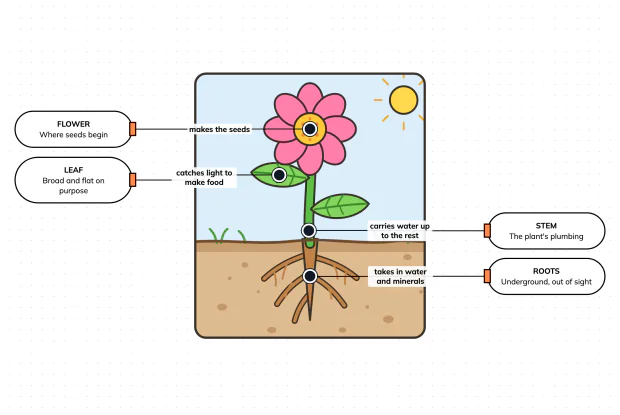
A plant is not one thing doing one job — it is four parts, each solving a different problem. Learn what roots, stem, leaf and flower each do, then label a plant yourself in an interactive playground.
What Are the Parts of a Flower, and How Do They Make a Seed?
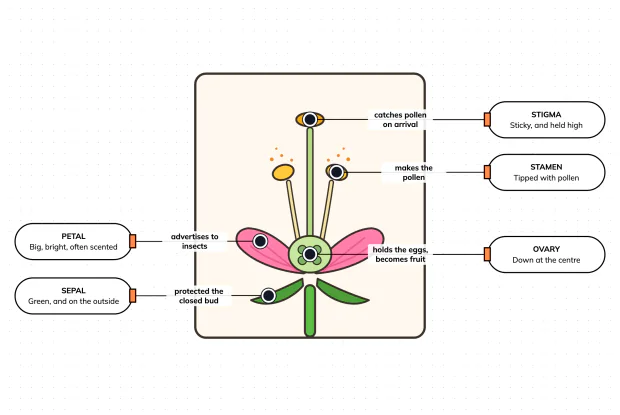
A flower is not decoration — it is the part of a plant whose job is the next plant. Learn what the petal, sepal, stamen, stigma and ovary each do, then label a flower yourself in an interactive playground.
How Does a Seed Become a Plant?
A seed sits doing nothing for months, then grows in total darkness without being fed. Learn the five steps of germination, and why the root always goes down before the shoot goes up, then build the sequence yourself in an interactive playground.