Why Shapes Behave the Way They Do
Geometry taught as vocabulary is a list of names for shapes; taught as reasoning it is a small number of rules that force everything else. This track does the second. It opens by sorting triangles on one question — how many sides are equal — and shows that the angles then follow with nothing measured, because equal sides force equal angles. The second part proves the fact the first one leaned on twice: draw a single extra line and a triangle's three angles line up along it, which is why they total 180 degrees, and which is also why the rule fails on a globe. The third part takes the word 'same' apart, because same shape and same size are two different claims, and the difference is what makes maps, scale models and the whole of trigonometry work. Nothing here needs memorising once the reasoning is in place.
CodePLU Goal
Upgrading Human Mental Models
Learn how to think in Workflows
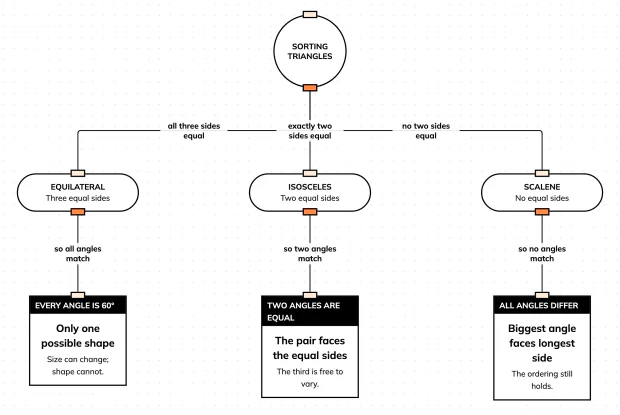
What Kinds of Triangle Are There?
Triangle types are usually memorised as a list of names. They are better understood as one decision — how many sides are equal — from which the angles follow with no extra information. Match each type to what its angles must do in an interactive playground.
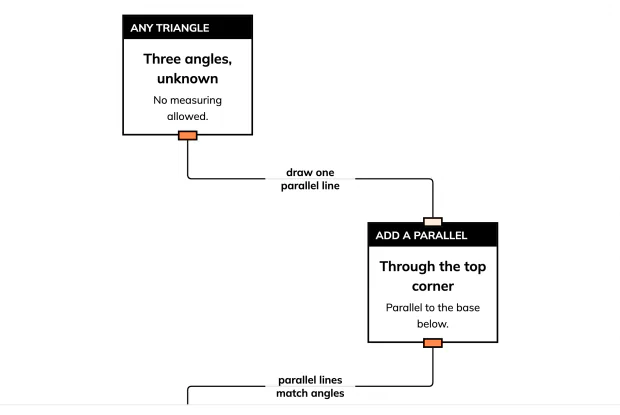
Why Do a Triangle's Angles Always Add to 180°?
Everyone is told that a triangle's angles total 180 degrees. Almost nobody is shown why, so it gets filed as a fact to trust. Follow the five-step proof from one parallel line to the conclusion and assemble the argument yourself in an interactive playground.
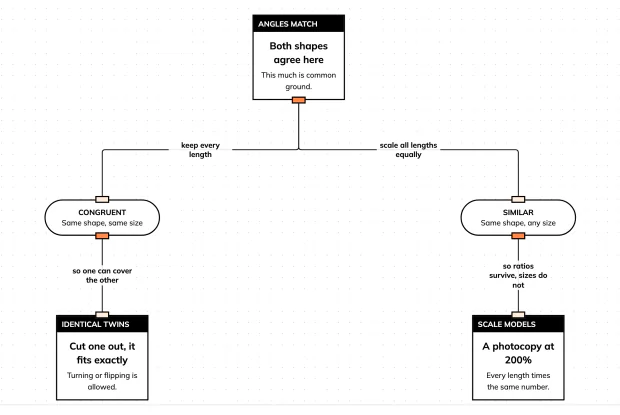
When Are Two Shapes Really the Same?
"The same" is ambiguous in geometry, and the ambiguity causes real errors. Learn the two precise versions — congruent and similar — and where they part, then build both branches in an interactive playground.