What Is an AI Agent Loop? How AI Makes Decisions
Root Concept
An AI agent works as a loop: observe the environment, decide based on a policy, take action, and learn from feedback.
CodePLU Goal
Upgrading Human Mental Models
Learn how to think in Workflows

Concept Development By codeplu.com
The AI agent decision loop — observe, decide, act, improve
What Is an AI Decision Loop?
Think about how you cross a busy street. You look at the traffic, judge whether it is safe, take a step — and if a car honks, you jump back and look again. Without noticing, you just ran a decision loop: observe, decide, act, and learn from what happened. An AI agent works exactly the same way.
An AI agent is any software or machine that senses its environment and acts on it to reach a goal. It runs the same four stages over and over: it observes signals from the world, decides on the best action using its policy (its decision-making rules), acts on the environment, and then uses feedback to improve its next decision. That repeating cycle is called the agent loop — and it is the beating heart of almost every 'smart' system you meet.
This one idea explains an enormous amount of modern technology. Your thermostat, your phone's assistant, a robot vacuum, a self-driving car, even the AI agents that browse the web and complete tasks for you — under the hood, they are all running some version of this loop, thousands of times, without getting tired.
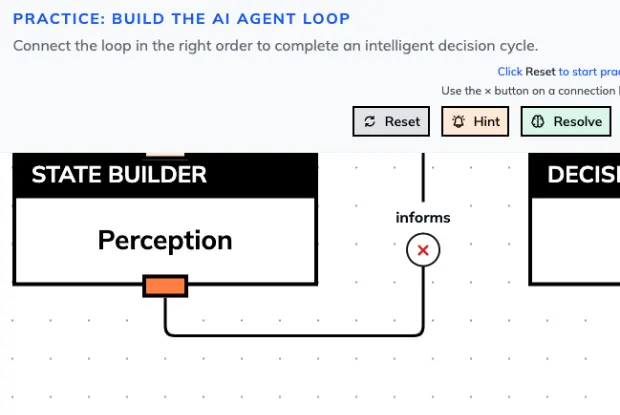
In the playground below, you will build the loop yourself: connect the stages in the right order and — most importantly — close the circle. When you see why the loop must come back to the start, you will understand something fundamental about how AI actually works.
How Does an AI Agent Loop Work, Step by Step?
What happens during observation?
Every loop begins with the agent collecting information about the world around it. A robot uses cameras and distance sensors, a thermostat reads temperature, and a recommendation system watches what you click. Whatever the source, the agent converts these raw signals into a state — a structured summary of what the world looks like right now. Here is a misconception worth clearing early: many beginners imagine that an AI 'sees' the world the way we do. It does not. To the agent, everything is numbers — a temperature of 17.5, a grid of pixels, a list of your last ten clicks. Observation is really translation: turning a messy world into tidy numbers. If those numbers are wrong or incomplete, every later step suffers — which is why real AI engineers spend so much of their time on good sensors and clean data.
How does an AI agent decide what to do?
Once the agent knows the current state, its policy takes over. A policy is simply the rule that connects what the agent sees to what it should do. It can be as basic as 'if the room is colder than 20°C, switch the heating on', or as sophisticated as a neural network weighing millions of learned patterns to choose a chess move. The misconception here is that the agent 'thinks it over' the way a person would. In reality, deciding is a calculation: state in, action out. What makes modern agents feel intelligent is not deliberation — it is that their policies have been shaped by enormous amounts of training and feedback, so the mapping from situation to action has become remarkably good.
What happens when the agent takes action?
A decision means nothing until the agent acts on the world: switch the heater on, steer two degrees left, recommend a video, send the reply. The action changes the environment — the room warms up, the car shifts in its lane, and you either click the video or scroll past it. And this is exactly why the loop is a loop. Changing the environment changes what the agent will observe next: the next observation reflects the result of the last action, so every pass around the cycle starts from a fresh situation. An agent that acted but never looked again would be flying blind — which is why, in the playground below, the loop must close back to the start.
Why is feedback the most important step?
Feedback is the agent's report card. After acting, the agent measures how well it did against its goal — was the room comfortable, did the passenger feel safe, did you actually enjoy the recommendation? That measurement adjusts the policy so the next decision is a little better. Beginners often assume AI improves automatically, as if intelligence simply accumulates on its own. It does not. Without feedback an agent will repeat the same mistake forever — perfectly and efficiently. Everything we call 'learning' in AI is really this: feedback nudging the policy, loop after loop, millions of times. Cut the feedback wire, and the smartest agent stops getting smarter that instant.
Real World Example
How Does a Smart Thermostat Run the Agent Loop?
A smart thermostat is one of the simplest true AI agents you can own, which makes it the perfect place to watch the loop run in real life. Follow one full cycle through a winter morning:
Step 1 — It observes
Several times a minute, the thermostat reads the room temperature, the humidity, the time of day, and whether anyone is home. Those readings become its state: 'It is 17°C, it is 7 a.m., and the family is waking up.'
Step 2 — It decides
Its policy compares that state with your comfort settings and its learned habits. Heating now costs energy; waiting risks a cold breakfast. The policy weighs the trade-off and picks an action: start heating.
Step 3 — It acts
The thermostat switches the boiler on. The environment immediately starts changing — the room begins to warm — which means its very next observation will already be different.
Step 4 — It learns from feedback
Later, it checks the result. Did the room reach 21°C by the time you got up? Did you override it because you felt cold? Every override is feedback, and feedback quietly adjusts its policy for tomorrow.
Step 5 — The loop never stops
The cycle repeats day and night. After a few weeks the thermostat 'knows' your household — not because it is clever, but because thousands of loops with feedback have tuned its policy to your life.
FAQs
Final Words
You have just built the mental model that sits underneath nearly all of modern AI. An agent is not magic: it is a loop — observe the world, decide with a policy, act on it, and let feedback sharpen the next round.
The detail that matters most is the one you practiced in the playground: the loop closes. Every action writes the first line of the next observation, and feedback quietly rewrites the policy in between. Systems that master this cycle feel intelligent; systems without it just repeat themselves.
From here you are ready for the natural next questions: what kinds of AI systems exist, and how does the 'learning' inside the feedback step actually work? Continue with Types of AI Systems and How AI Learns — both build directly on the loop you just closed.
Continue This Track
This concept is part 3 of What AI Can Actually Do.
What Are the Types of AI? Narrow, General, and Super AI
Learn how artificial intelligence is categorized based on its capabilities, from highly specialized tools to theoretical super-intelligence.
How Does AI Learn? From Raw Data to Smart Predictions
See how AI really learns — collect, clean, train, test, use — explained simply with an interactive workflow you build yourself.
What Is an AI Agent Loop? How AI Makes Decisions
Learn how an AI agent observes, decides, acts, and improves — then build the decision loop yourself in an interactive playground.
What Can AI Do — and What Can It Not Do?
AI's real strengths and blind spots explained simply — with an interactive playground where you sort abilities into what AI can and cannot do.