What Is Machine Learning?
Root Concept
Machine learning flips traditional programming on its head: instead of a person writing the rules, the computer studies solved examples and works out the rules itself.
CodePLU Goal
Upgrading Human Mental Models
Learn how to think in Workflows

Concept Development By codeplu.com
One task, two ways to reach it — and the fork is who writes the rules
What Is Machine Learning, in Plain Words?
Think about how you learned to recognize a dog. Nobody handed you a rulebook that said 'four legs, fur, tail, wet nose.' You simply saw hundreds of dogs as a child, and your brain quietly worked out what makes a dog a dog. One day you could spot a breed you had never seen before — and still know instantly that it was a dog. Machine learning gives computers that same trick: learning from examples instead of following a rulebook.
This is a genuine flip in how software gets built. For most of computing history, a person had to write every rule the computer follows, step by step. Machine learning turns that around: you show the computer lots of solved examples — questions together with their correct answers — and the computer works out the rules on its own.
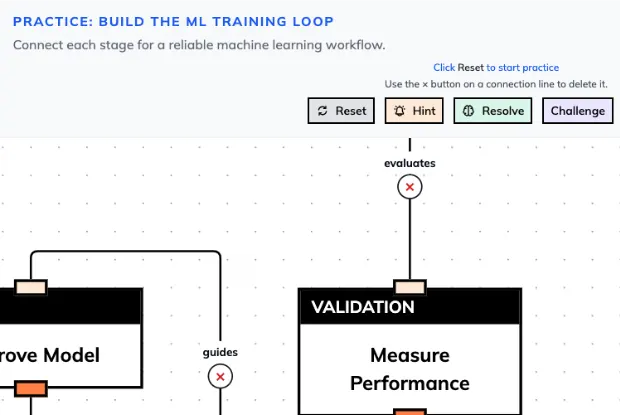
In the playground above, you will build both paths down from the one task they share — and the label on the fork is the whole difference: whether a person writes the rules or the computer works them out. Once you can tell these two paths apart, the whole field of AI becomes much easier to understand.
How Is Machine Learning Different From Normal Programming?
How does traditional programming actually work?
Traditional programming works like writing a recipe for a very obedient but completely unimaginative cook. A person thinks through the problem, writes exact instructions — 'if the number is bigger than 100, do this; otherwise, do that' — and the computer follows them to the letter. Nothing more, nothing less. This works beautifully when the rules are clear and known: calculating a bill, sorting names alphabetically, showing your bank balance. Many beginners assume computers are smart on their own. They are not. A traditionally programmed computer has zero ideas of its own — every ounce of 'intelligence' in it was typed in by a person. And that is exactly its weakness: if the person cannot write the rule down, the computer cannot do the job.
How does machine learning flip the process?
Now try to write the rules for recognizing a friend's face. What would you even type? 'Eyes roughly 6 cm apart'? People tried for decades to hand-write rules for tasks like this, and they failed — some things are easy to do but impossible to explain. Machine learning takes the opposite route: instead of explaining, you demonstrate. You collect thousands of examples where the answer is already known — this photo is your friend, this one is not — and let the computer hunt for the pattern that connects the inputs to the answers. In traditional programming, rules go in and answers come out. In machine learning, examples go in and rules come out. That single sentence is the heart of this entire tutorial.
What exactly is a 'model' in machine learning?
The rules the computer discovers do not float around loosely — they get packed into something called a model. A model is simply the learned rules, saved in a form the computer can reuse. Think of it as the recipe the computer wrote for itself after tasting a thousand dishes. Show the finished model a brand-new case it has never seen — a new photo, a new email, a new house — and it applies its learned rules to produce an answer. A common misconception is that a model keeps all the training examples inside it, like a photo album. It does not. It keeps only the patterns it squeezed out of them — just as you remember what dogs look like without storing every dog photo you ever saw.
When is machine learning better than writing rules?
It is tempting to think machine learning is simply the modern replacement for programming. It is not — each approach has its home ground. If the rules are clear, fixed, and known — a tax calculation, a game's scoring system — writing them by hand is faster, cheaper, and easier to trust. Machine learning earns its keep when the rules are too fuzzy or too many to write down: recognizing speech, spotting a fraudulent card payment, guessing which song you will enjoy next. A good rule of thumb: if you can explain the task to a new employee in a page of instructions, program it. If you would rather show them a hundred examples and say 'you'll get the feel for it,' that is a machine learning problem.
Real World Example
How Does Your Email Know a Message Is Spam?
Your inbox quietly runs one of the oldest machine learning success stories. Walking through it shows exactly why the flip from written rules to learned rules matters.
First, people tried writing the rules by hand
Early spam filters were pure traditional programming. Engineers wrote rules like 'block any email containing the words FREE MONEY.' It worked — for about a week. Spammers simply changed the spelling to 'FR3E M0NEY' and sailed straight past the rule.
The rulebook turned into an unwinnable game
Engineers added more rules, spammers invented more tricks, and the rulebook grew into a tangled mess of thousands of exceptions. Every fix broke something else — real emails from friends started landing in the spam folder. The task was simply too slippery for hand-written rules.
Then came the flip: show, don't tell
Instead of describing spam, engineers collected hundreds of thousands of real emails that users had already marked as spam or not spam. No rules were written at all — just examples with known answers, exactly like the machine learning path you built in the playground.
The computer found patterns no one had written down
Studying the examples, the computer noticed subtle combinations humans never put in any rulebook — certain word mixes, strange links, odd sending patterns at odd hours. It packed everything it learned into a model: its own self-written recipe for spotting spam.
Now new tricks are beaten with new examples
When a fresh email arrives, the model scores it against its learned patterns in a split second. And when spammers invent a new trick? Nobody rewrites rules. The filter is simply retrained on fresh examples — and learns the new trick on its own. That is the machine learning advantage in one sentence.
FAQs
Final Words
You now hold the single most useful sentence in all of AI: in traditional programming, rules go in and answers come out; in machine learning, examples go in and rules come out. In the playground you built both paths yourself — the hand-written recipe that is only as good as its author, and the learned model that improves with every fresh batch of examples.
You also know when each path wins: clear, fixed rules belong to traditional programming; fuzzy, hard-to-explain tasks belong to machine learning. With the flip firmly in your head, you are ready for the natural next question — how exactly does that learning happen? That is the story of collecting, training, and testing, waiting for you in the next concept.
Continue This Track
This concept is part 1 of How Machines Learn From Data.
What Is Machine Learning?
Discover how machine learning flips traditional programming on its head: instead of writing rules for the computer, you show it examples and it works out the rules itself.
What Are the Types of Machine Learning?
Machines learn in three different ways — from examples with answers attached, from data with no answers at all, or by trying things and being rewarded. Learn which kind suits which job.
What Is the Machine Learning Workflow?
Walk through the five steps every machine learning project follows — collect, prepare, train, evaluate, deploy — and the loop-back that saves projects when the model fails its exam.
What Happens Inside the Machine Learning Training Loop?
Step inside the training loop — the repeating guess-check-adjust cycle that turns a clueless model into a skillful one, one tiny correction at a time.