What Is Data Science?
Root Concept
Data science is the work of turning data into a decision — it sits between the engineer who delivers the data and the analyst who reports what happened, and its job is to say what is likely and what to do next.
CodePLU Goal
Upgrading Human Mental Models
Learn how to think in Workflows

Concept Development By codeplu.com
Deliver the data, explain the past, estimate the unknown — three data jobs, three questions
What Does a Data Scientist Actually Do?
A supermarket manager has a problem: too much bread goes unsold on Mondays, and too little on Fridays. Somewhere in the shop's records lies the answer, but records are not answers. Someone has to turn those thousands of rows into a sentence the manager can act on — 'bake 30% less on Mondays' — and be right often enough to trust.
That is data science. It is the work of turning data into decisions, and the last word matters most: a project that produces a beautiful chart nobody acts on has not succeeded. It sits between two neighbouring jobs that people constantly confuse with it — the data engineer who makes sure the data arrives at all, and the data analyst who explains what already happened.
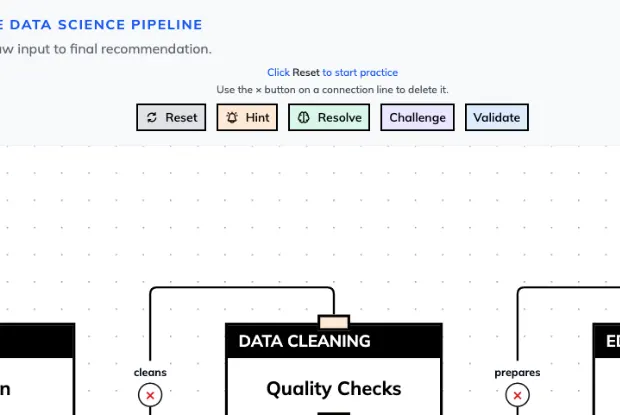
You do not need mathematics to understand the field, only to practise it at depth. What you need first is the shape of the work: a real question, evidence gathered honestly, patterns tested rather than assumed, and a recommendation someone can act on. In the playground above you will build data science down into its three jobs, each one reached by the question that lands on their desk.
How Should You Understand Data Science?
Why does every data science project start with a question?
Because data alone points nowhere. 'Look at our sales data and find something interesting' is the most common way a project dies quietly — with enough numbers you can always find something that looks interesting and means nothing. A real question sounds different: 'Which customers are likely to cancel next month, so we can call them first?' It names who will act, what they will do, and when. Many beginners assume the skill is in the analysis, and the question is the easy part. In practice, choosing the question is most of the job, and it is why good data scientists spend so much time talking to the people with the problem.
How is data science different from data analysis?
An analyst looks backwards with precision: what happened, where, how much. Sales fell twelve per cent in the north last quarter — that is analysis, and it is genuinely valuable. A data scientist is asked something harder: what is likely to happen, and what should we do about it. Which customers will leave, what price will sell best, is this transaction fraudulent. Because the answer concerns something not yet in the data, the work leans on statistics and often on machine learning. The honest summary is that analysis reports, and data science estimates — and estimating always comes with a chance of being wrong.
What does the data engineer do that a scientist relies on?
Before anyone can analyse anything, the data has to exist somewhere reachable, refreshed reliably, without losing half the records on a Sunday night. That plumbing is data engineering, and it is invisible until it breaks. It matters to you as a beginner for one practical reason: much of what feels like a data science failure is really a data supply problem. If the sales table quietly stopped updating three weeks ago, the cleverest model in the world will confidently answer using stale numbers. Learning to ask 'where did this data come from, and is it still arriving?' will save you more embarrassment than any algorithm.
Do you need to be a mathematician to do data science?
To understand the field, no. To work at depth in it, you will need statistics — and this is worth being straight about rather than encouraging. What you need at the start is different and often rarer: curiosity about how something really works, patience with messy records, and the discipline to check whether a pattern holds up instead of falling in love with it. Plenty of capable data scientists came from biology, journalism, or accounting, and their subject knowledge was an advantage rather than a gap, because knowing what a number should look like is how you catch the ones that are wrong.
Why must a project end in a decision, not a chart?
Because an insight nobody acts on changes nothing. The finished product of data science is not a dashboard, a model file, or a slide deck — it is somebody doing something differently: baking less bread on Mondays, calling those four hundred customers, blocking that transaction. This is why communication is treated as a core skill rather than a nice extra. A correct finding explained badly to the person who could act on it has the same real-world value as no finding at all. Judge your own work by what changed afterwards, and you will make better choices at every earlier step.
Real World Example
How Would a Data Scientist Fix the Bread Problem?
Follow the supermarket's unsold-bread problem from a vague complaint to a change in behaviour, and notice how many steps are not maths.
Turn the complaint into a question someone can act on
The manager says 'we waste too much bread'. That is not yet answerable. It becomes: 'How many loaves should we bake each day of the week so that we run out no more than once a fortnight?' Now there is a number to produce and a person who will use it.
Find out what data actually exists
Two years of till receipts exist, which is excellent. Records of days the shelves emptied early do not, which matters — those days looked like low sales when demand was actually high. Knowing this gap up front is worth more than any clever technique applied later.
Clean what turns up, because it is messy
The bread category includes croissants for the first six months and then stops. Two tills recorded prices in different formats. A refrigeration failure wiped out one strange week. All of it has to be sorted out honestly before any pattern can be believed.
Look for the pattern, then try to break it
Mondays are consistently quiet, Fridays busy, and rain suppresses walk-in trade. The important discipline comes next: check the pattern against months held back from the analysis. If it only worked on the data used to find it, it was a coincidence dressed as an insight.
Deliver a decision, then watch what happens
The recommendation is concrete: bake thirty per cent fewer loaves on Mondays, ten per cent more on Fridays, and adjust down when heavy rain is forecast. Waste drops, and the shop keeps measuring — because a decision that stops being checked slowly becomes wrong.
FAQs
Final Words
Data science is the work of turning data into decisions. In the playground you separated it from its two neighbours: the engineer who makes sure the data arrives, and the analyst who explains what already happened. The data scientist takes on the harder question — what is likely, and what should we do.
Carry three things forward. Start with a question someone will act on, not with a pile of data. Distrust a pattern until it survives data you did not use to find it. And judge your work by what changed afterwards. Next comes the practical shape of that work, step by step: the data analysis workflow.
Continue This Track
This concept is part 1 of Data Science From the Ground Up.
What Is Data Science?
Data science is not just charts and not just coding. Learn what it really is by seeing how it differs from the two jobs sitting either side of it — and why it always ends in a decision.
What Are the Types of Data?
Some data arrives in tidy rows, some arrives with labels but no table, and some arrives as photos and voice notes. Learn to tell the three types apart and what each one costs you to use.
What Are the Steps of the Data Analysis Workflow?
Most beginners start with data and hope a chart shows something. Professionals start with a question. Walk the five steps of a real analysis, from the question to the answer someone acts on.
How Do You Clean Messy Data Before Analysing It?
Real data arrives broken: duplicates, blanks, mismatched formats, and impossible values. Learn what each mess does to your answer and the fix that clears it.