What Are the Types of Machine Learning?
Root Concept
There are three ways a machine can learn: from examples where the answer is given, from data where no answers exist, or by trying actions and being rewarded — and the kind of data you have decides which is possible.
CodePLU Goal
Upgrading Human Mental Models
Learn how to think in Workflows
Concept Development By codeplu.com
Machine learning branches on what the training data brought with it
How Many Ways Can a Machine Learn?
Think about three ways you have learned things. At school, you did practice questions and a teacher marked them right or wrong — you learned from examples with answers attached. Sorting a drawer of loose photographs into piles, nobody told you what the piles should be; you noticed which pictures belonged together. And learning to ride a bicycle, nobody could mark your answers at all — you tried, wobbled, fell, adjusted, and gradually got further before falling.
Machines learn in exactly those three ways, and each has a name: supervised learning for the marked practice questions, unsupervised learning for the photo piles, and reinforcement learning for the bicycle. Same underlying idea of improving through practice, but three quite different situations.
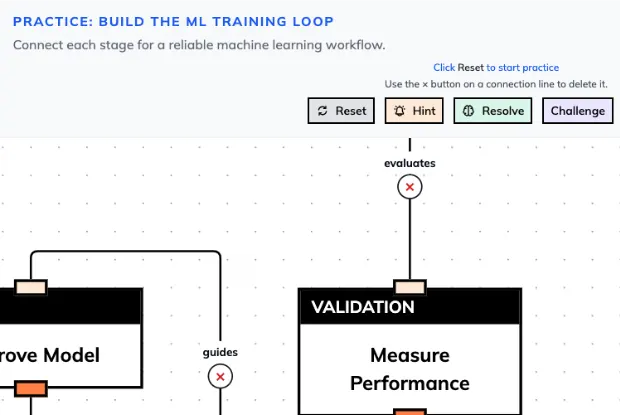
Which one you use is not really a preference — it is decided by what you have. If your examples come with answers attached, one path opens. If they do not, another. And if the machine can act and receive a score for the result, a third. In the playground above you will build machine learning down into its three kinds, each one settled by what came with the data.
What Are the Three Kinds of Learning?
What is supervised learning, in plain words?
It is learning from worked examples: every example comes with the correct answer attached, so the machine can check itself and improve. Photos labelled cat or dog, past loans marked repaid or defaulted, houses with the price they actually sold for. This is the most common kind in real products because it is the most straightforward — you know what right looks like, so you can measure how wrong the model is. Its catch is the labels. Somebody, usually a person, had to mark all those examples, and that work is slow and expensive. Many promising projects stall not for lack of data but for lack of labelled data.
What can unsupervised learning do without any answers?
It finds structure nobody pointed out. Give it your customers with no labels and it can group the ones who behave alike; give it transactions and it can flag the handful that look unlike everything else. Notice what it cannot do: it cannot tell you what the groups mean. It might split your customers into four clusters, and interpreting them — 'these are bargain hunters, these buy gifts' — is a human job. That is the trade. You need no labels, which is liberating, but you get patterns rather than answers, and you have to decide whether they are useful.
How does reinforcement learning work?
By trying things and being scored. There is no dataset of right answers, only an environment the machine can act in and a signal telling it how well that went — points for progress, penalties for failure. Over enormous numbers of attempts it learns which actions tend to lead to good scores. This is how systems learn to play games and how robots learn physical movement, and its distinctive requirement is that failure must be cheap. A machine can fall over ten million times in a simulator; it cannot crash ten million real cars. That is why so much of this work happens in simulation first.
How do you tell which type a problem needs?
Ask what you actually hold. Do you have examples with the answer attached? Then supervised learning, and it is usually the simplest route. Do you have data but no answers, and you are hoping to discover structure rather than predict something specific? Then unsupervised. Can the machine act repeatedly, cheaply, and get scored on the result? Then reinforcement. Beginners often pick the type that sounds most impressive, which is backwards — reinforcement learning is the most glamorous and the least applicable to ordinary business problems, while unglamorous supervised learning quietly runs most of the AI you use every day.
Do real systems use only one type?
Often not, and the modern AI you use daily is a good example. Large language models begin with a huge amount of self-supervised training, where the answer is hidden inside the data itself — cover up the next word and the text supplies the correct answer, so no human labelling is needed. Then people rate the answers, and a reinforcement-style step nudges the model toward the replies humans preferred. So one product can involve several kinds of learning stacked in sequence. The three types are best understood as tools rather than tribes, and knowing which is which tells you what a system needed in order to exist.
Real World Example
How Would One Supermarket Use All Three?
A supermarket chain has three quite different questions. Watch how the data available decides the approach in each case.
Problem one: how much bread will sell tomorrow?
They hold years of daily sales with the actual number sold each day — examples with the answers attached. That makes this supervised learning: the model learns from history and its predictions can be checked against what really happened, so accuracy is measurable from day one.
Problem two: what kinds of shoppers do we have?
Nobody has ever defined the customer types, so there are no labels to learn from. Unsupervised learning groups shoppers whose baskets look alike, and it produces five clusters. The machine does not name them — the marketing team looks and recognises 'big weekly shops', 'lunchtime grabs', and so on.
Problem three: how should the warehouse robots move?
There is no dataset of correct movements, but a robot can attempt a route and be scored on time taken and collisions avoided. That is reinforcement learning, and it is trained in simulation first — because a real robot cannot afford millions of failed attempts.
Why the choice was never really a choice
Each type was forced by the situation. Labelled history made the first one supervised. The absence of labels made the second unsupervised. The ability to try and be scored made the third reinforcement. Asking 'which type should we use?' before looking at the data gets the order backwards.
What ties them together
All three still follow the same underlying loop you already know: try, check how it went, adjust, repeat. What differs is only where the feedback comes from — a labelled answer, the shape of the data itself, or a score from the environment.
FAQs
Final Words
Machines learn in three ways: from marked practice questions, from unlabelled data where they must find their own groupings, and by trying actions and being scored. In the playground you matched three real jobs to the learning each one made possible — labelled loans, unlabelled customers, and a robot that can try and be rewarded.
The habit to keep is looking at your data before choosing an approach, because the data decides and prestige misleads. And remember that all three still run the same underlying loop of try, check, adjust — only the source of the feedback changes.
Continue This Track
This concept is part 2 of How Machines Learn From Data.
What Is Machine Learning?
Discover how machine learning flips traditional programming on its head: instead of writing rules for the computer, you show it examples and it works out the rules itself.
What Are the Types of Machine Learning?
Machines learn in three different ways — from examples with answers attached, from data with no answers at all, or by trying things and being rewarded. Learn which kind suits which job.
What Is the Machine Learning Workflow?
Walk through the five steps every machine learning project follows — collect, prepare, train, evaluate, deploy — and the loop-back that saves projects when the model fails its exam.
What Happens Inside the Machine Learning Training Loop?
Step inside the training loop — the repeating guess-check-adjust cycle that turns a clueless model into a skillful one, one tiny correction at a time.