What Happens Inside the Machine Learning Training Loop?
Root Concept
Inside training, a model improves through one repeating cycle: take an example, guess the answer, check the miss, adjust — millions of tiny corrections that quietly add up to skill.
CodePLU Goal
Upgrading Human Mental Models
Learn how to think in Workflows
Concept Development By codeplu.com
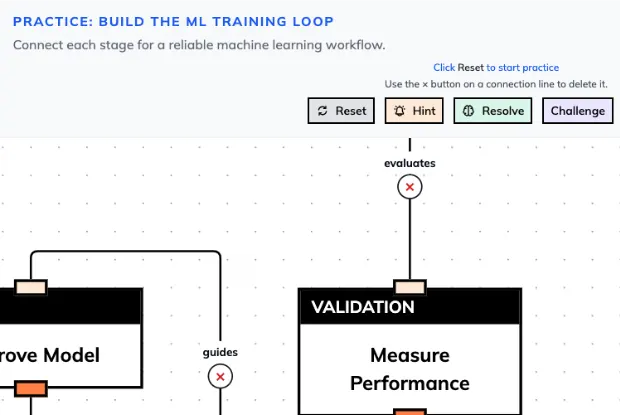
The training loop: take an example, guess, check the miss, adjust — and around again
What Is the Training Loop, in Plain Words?
Think about learning to throw darts. Your first throw lands nowhere near the bullseye. But you see exactly where it landed, so your next throw corrects a little — too far left becomes a little more right. Throw after throw, each miss teaches your arm a tiny lesson, and an hour later you are hitting close to center. Nobody explained dart physics to you. The loop of try, see the miss, and adjust did all the work.
That loop is precisely how a machine learning model learns. Earlier concepts showed you the big picture — collect data, prepare it, train, evaluate, deploy. This tutorial zooms into the step everyone treats as a black box: training itself. Inside it, one small cycle repeats millions of times: take a practice example, guess the answer, check how far off the guess was, and adjust a little. Then the next example, and around again.
In the playground above you will build this cycle yourself — all four beats, plus the edge that makes it a loop rather than a line. Once you see it, 'the model is training' stops being magic and becomes something wonderfully ordinary: practice.
How Does One Trip Around the Loop Work?
What are the four beats of the training loop?
Every trip around the loop has the same four beats. First, take an example — one practice question whose correct answer is already known, like a photo already labeled 'cat'. Second, guess: the model produces its answer, and early on these guesses are almost comically wrong. Third, check the miss: the guess is compared with the known answer to see how far off it was. Fourth, adjust: the model's internal settings get nudged slightly in the direction that would have made the guess better. Then the loop grabs the next example and goes around again. One trip teaches the model almost nothing — the power is in repetition, exactly like one dart throw versus a thousand.
How does the model know how wrong it was?
The miss is not a feeling — it is a number. If the model guessed a house costs 500,000 and the real sale price was 300,000, the miss is 200,000. If it guessed 'dog' with high confidence and the answer was 'cat', the miss is large; a hesitant wrong guess counts as a smaller miss. Engineers call this number the error — the measured size of the miss. Here is the misconception worth dropping now: many beginners imagine the model 'understands' it made a mistake, maybe even feels bad about it. It does not. The entire drama of learning boils down to one goal a machine can follow: make this number smaller on the next trip around.
How does adjusting actually work?
Inside every model live thousands or even billions of adjustable settings — think of them as tiny volume dials that together decide the model's guess. Adjusting means turning each dial a tiny bit in the direction that would have shrunk the miss. Why tiny? Imagine correcting your dart throw by hurling the next dart twice as hard the other way — you would overshoot wildly and never settle. Small, patient corrections let the dials drift steadily toward values that work. A common beginner picture is one big 'aha' fix, like a student suddenly getting it. Real training has no aha moment — just millions of nudges so small that each one is invisible, adding up to skill.
When does the loop stop?
The loop does not run forever. The model works through all its examples — one full pass is called an epoch, simply a round of practice — and then starts another round. Watchers track the misses: early rounds shrink them dramatically, later rounds barely move them. When the misses stop improving, training stops. And stopping matters more than beginners expect, because a loop that runs far too long starts memorizing its practice questions instead of learning the pattern — like a student who reheats the same past papers until they know the answers by heart but not the subject. That failure has a name, overfitting, and it is exactly what the final exam on unseen data — evaluation — is designed to catch.
Real World Example
How Does a Food App Learn to Predict Delivery Time?
A food delivery app wants to show 'your order arrives in 32 minutes' — and be right. Its model learns that skill by looping over thousands of past orders whose real delivery times are known.
Take an example: one past order
The loop picks a solved practice question from history: an order placed on a rainy Friday evening, from a restaurant 3 kilometres away, that actually took 41 minutes door to door. The real answer — 41 — is the truth the guess will be checked against.
Guess: the untrained model embarrasses itself
The fresh model's dials start at random, so its first prediction is nonsense — it guesses 7 minutes. That is fine. Every learner starts terrible; what matters is what happens with the miss.
Check the miss: 34 minutes off
The guess is compared with the truth: 41 minus 7 means the model was 34 minutes too optimistic. That single number — the size of the miss — is all the feedback the model gets. No lecture, no explanation. Just: you were this far off, in this direction.
Adjust: every dial gets a tiny nudge
The settings that pushed the guess too low — the ones underweighting rain, distance, and Friday-evening traffic — each get turned slightly the other way. Not fixed in one stroke: nudged. The next rainy-Friday guess will be a little less wrong.
Around again — a million orders later
The loop grabs the next order, and the next, looping through months of history round after round. The misses shrink from 34 minutes to 10 to 3. When they stop improving, training ends — and the model faces its real exam: predicting orders it has never seen. That story continues in the evaluation step of the ML workflow.
FAQs
Final Words
You have opened the black box of training and found something refreshingly simple inside: a four-beat cycle — take an example, guess, check the miss, adjust — spinning millions of times. No understanding, no aha moment, just patient practice where every miss nudges thousands of tiny dials a little closer to right. You built that cycle in the playground, including the edge that makes it a loop.
Carry two ideas forward: skill comes from repetition plus feedback, and more repetition is not always better — memorization lurks past the point where misses stop shrinking. That is why the training loop always hands its graduate over to an exam on unseen questions. How that exam fits into the full journey is the story of the machine learning workflow.
Continue This Track
This concept is part 4 of How Machines Learn From Data.
What Is Machine Learning?
Discover how machine learning flips traditional programming on its head: instead of writing rules for the computer, you show it examples and it works out the rules itself.
What Are the Types of Machine Learning?
Machines learn in three different ways — from examples with answers attached, from data with no answers at all, or by trying things and being rewarded. Learn which kind suits which job.
What Is the Machine Learning Workflow?
Walk through the five steps every machine learning project follows — collect, prepare, train, evaluate, deploy — and the loop-back that saves projects when the model fails its exam.
What Happens Inside the Machine Learning Training Loop?
Step inside the training loop — the repeating guess-check-adjust cycle that turns a clueless model into a skillful one, one tiny correction at a time.