What Are the Steps of the Data Analysis Workflow?
Root Concept
A real analysis runs question first: decide what you need to know, gather only the data that answers it, clean it, explore honestly, and deliver an answer someone can act on.
CodePLU Goal
Upgrading Human Mental Models
Learn how to think in Workflows

Concept Development By codeplu.com
Question, collect, clean, explore, answer — the workflow of a real analysis
Where Does a Real Analysis Actually Begin?
Here is how most beginners start: open the spreadsheet, make some charts, and hope something jumps out. It feels productive, and it usually produces the same result — a handful of pretty pictures and no decision. The order is simply wrong.
A real analysis begins before the data does, with a question specific enough to be answered and useful enough that somebody is waiting for the answer. 'How many of our new customers come back within thirty days?' is a question. 'Let's look at the customer data' is not. Everything after that flows from it: the question decides what data you need, and how clean it has to be.
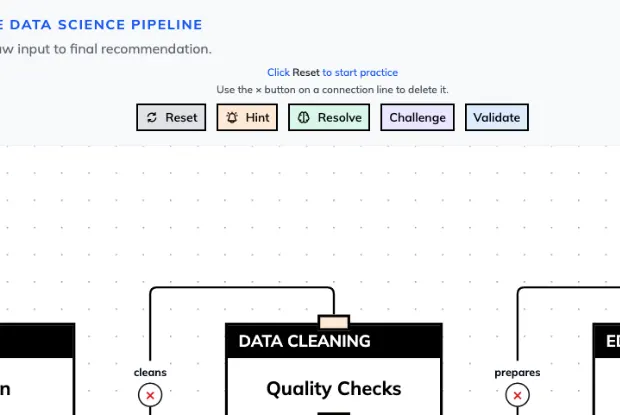
The five steps are ask, collect, clean, explore, answer — and the last one is not a chart. It is a sentence a decision-maker can use. In the playground above you will build this flow in order, and the first node will remind you where the real starting point is.
What Happens at Each Step of the Workflow?
How do you turn a vague request into a clear question?
Vague requests arrive constantly: 'we need to understand our customers better'. Nothing there tells you what to calculate. Sharpen it by asking who will act on the answer and what they will do differently, and it becomes something like 'which two customer groups have the lowest repeat-purchase rate, so marketing can target them next month?' Now the calculation is obvious and the finish line is visible. This step is also where you decide what would count as an answer, before you look — which protects you from the very human habit of hunting until the numbers say something you like.
Why collect only the data the question needs?
It is tempting to grab everything available in case it proves useful. Resist it: every extra column is more to clean, more to misunderstand, and more chances to find a coincidence. Start from the question and list what would genuinely be required to answer it, then find those fields. Just as importantly, check where each one comes from and how it is recorded, because a column named 'signup_date' can mean the day someone registered, the day they first paid, or the day a sales rep typed it in. Assumptions made here quietly become mistakes in your conclusion.
Why does every real dataset need cleaning first?
Because data is created by people and systems, and both are inconsistent. You will find blank cells, the same customer entered twice with slightly different spellings, dates in three formats, prices stored as text, and impossible values like an age of 214. None of this is unusual — it is the normal state of real data, and skipping past it means every later number is quietly wrong. The rule worth remembering is that an analysis can only be as trustworthy as the data underneath it, so cleaning is not a chore before the real work. It is part of the real work.
How do you explore data without fooling yourself?
Exploring means looking at how things are distributed, comparing groups, and checking how measures move together. The danger is that with enough columns something always looks striking, and it is easy to fall in love with the first interesting thing you see. Professionals do the opposite of celebrating: they try to break the pattern. Does it hold in other months, other regions, other customer types? Could something else explain it — a holiday, a price change, a broken sensor? A finding that survives honest attempts to knock it down is worth reporting. One that does not survive was noise.
Why is the final step an answer rather than a chart?
Because a chart still asks the reader to do the interpreting, and busy decision-makers will not. Your job is to state the conclusion in a sentence, back it with the one or two visuals that show it most clearly, and be honest about what would change your mind. 'New customers who buy within a week are three times more likely to return; we should push the first repeat purchase harder' is an answer. A dashboard with fourteen panels is homework. Say what you found, what you recommend, and how confident you are — including the limits, because trust is what gets your next finding acted upon.
Real World Example
How Would You Analyse Why a Café Loses Customers?
A café owner feels regulars are drifting away. Follow the workflow from that hunch to an answer she can act on, and notice how much happens before any chart appears.
Step one: sharpen the worry into a question
'We're losing regulars' cannot be calculated. It becomes: 'Of customers who visited at least three times in a month, what share stopped coming in the following two months, and does that differ by when they usually visit?' Now there is a number, and the owner knows what she would do with it.
Step two: collect only what answers it
The loyalty app records visit dates, times, and rough order type. That is enough. Tempting extras — staff rotas, weather, social media followers — are left alone for now, so they cannot muddy the analysis or eat the week.
Step three: clean what turns up
Some customers have two accounts from changing phone number. A software update in March recorded every visit twice. Twelve visits are timestamped at 3am, when the café is shut. Each has to be resolved, and each would have distorted the result if ignored.
Step four: explore, then attack the pattern
Morning regulars stay loyal; afternoon regulars drift away twice as fast. Before believing it, she checks other quarters — same result. She looks for other explanations, and finds a real one: a competitor opened nearby in spring, with afternoon offers. The pattern survives, with a cause attached.
Step five: answer, recommend, and keep watching
The answer is one sentence: afternoon regulars are leaving twice as fast as morning ones, most likely to the new café down the road. The recommendation is an afternoon loyalty reward, trialled for six weeks with the same measurement repeated — so she will know whether it worked rather than assuming.
FAQs
Final Words
The workflow is short to say and easy to get wrong: ask a clear question, collect only the data it needs, clean what arrives, explore while trying to disprove yourself, and deliver an answer someone can act on. In the playground you built it in that order — and the first node is the one beginners skip.
Two habits do most of the work. Refuse to start until the question names who will act and on what. And treat a striking pattern as a suspect rather than a discovery until it survives data you did not use to find it. Next comes the step that consumes more time than any other, and the one this workflow depends on: turning messy data into data you can trust.
Continue This Track
This concept is part 3 of Data Science From the Ground Up.
What Is Data Science?
Data science is not just charts and not just coding. Learn what it really is by seeing how it differs from the two jobs sitting either side of it — and why it always ends in a decision.
What Are the Types of Data?
Some data arrives in tidy rows, some arrives with labels but no table, and some arrives as photos and voice notes. Learn to tell the three types apart and what each one costs you to use.

What Are the Steps of the Data Analysis Workflow?
Most beginners start with data and hope a chart shows something. Professionals start with a question. Walk the five steps of a real analysis, from the question to the answer someone acts on.
How Do You Clean Messy Data Before Analysing It?
Real data arrives broken: duplicates, blanks, mismatched formats, and impossible values. Learn what each mess does to your answer and the fix that clears it.